AI Course NZ: Your Guide to AI Course Options in Aotearoa
Imagine trying to run your Kiwi business today without the internet. It seems impossible, right? In just a few years, we'll feel the exact same way about Artificial Intelligence. That's why the demand for a quality AI course NZ professionals can rely on is exploding. AI isn't some far-off concept anymore; it's a practical toolkit helping businesses solve real problems, right now.
Why AI Skills Are Becoming a Must-Have in New Zealand
Artificial Intelligence is fast becoming a core part of how Kiwi businesses operate. Think of a local café in Queenstown using AI to forecast how much milk to order, or an Auckland construction firm automating its entire invoicing process. The applications are real and the impact is immediate.
This isn't just a trend for tech companies. It's fundamentally changing how we work across trades, hospitality, healthcare, and e-commerce.
For many professionals and business owners, this shift is both a huge opportunity and a bit of a challenge. The biggest hurdle? A major skills shortage is holding Kiwi businesses back. This isn't just a small inconvenience; it's a critical barrier stopping local companies from competing on the world stage.
The Growing Skills Gap in Aotearoa
New Zealand is facing a serious lack of AI expertise. The Datacom State of AI Index survey revealed that 43% of businesses not using AI right now cite this skills gap as the main reason.
The problem is compounded by our smaller population and the fierce global competition for tech talent. This makes it incredibly tough for local firms to find and hire specialists in areas like machine learning.
It's a reality that makes upskilling the people you already have more important than ever. Rather than hunting for that one elusive expert, smart businesses are now focusing on training their own teams.
The goal isn't to turn every staff member into a data scientist. It's about building a solid understanding of what AI can do for your business - whether that’s handling customer bookings around the clock or crafting marketing campaigns that actually hit the mark.
Staying Competitive in a Changing Market
Getting a handle on AI is one of the best moves you can make to future-proof your career or your business. For an individual, it makes you more adaptable and valuable. For a business, it unlocks new efficiencies and pathways to growth.
Figuring out how AI training fits into your wider organisational learning and development strategy is key to building a team that's ready for what's next.
This shift will fundamentally change how work gets done, creating new jobs while transforming existing ones. To get a better sense of this transformation, have a look at our guide on the future of work with AI in NZ.
Ultimately, finding the right AI course isn't just for developers anymore. It’s a vital step for any forward-thinking professional in New Zealand.
Decoding Your AI Learning Options in New Zealand
Trying to pick the right AI learning path in New Zealand can feel a bit like staring at a giant, confusing map. To make sense of it, let's use an analogy. A full university degree is like training to be a master architect - you learn the deep, fundamental principles to design complex systems from scratch. An intensive bootcamp, on the other hand, is like an apprenticeship to become a master builder, where the focus is squarely on getting you job-ready with practical, hands-on skills.
Each path has a different destination in mind, and the best AI course in NZ is simply the one that aligns with your specific career or business goals. It doesn't matter if you're an e-commerce store owner in Christchurch trying to make sense of customer data or a real estate agent in Tauranga wanting to automate lead follow-ups - there's an option built for you.
The demand for these skills isn't just a trend; it's a fundamental shift in how our economy works, as this hierarchy shows.
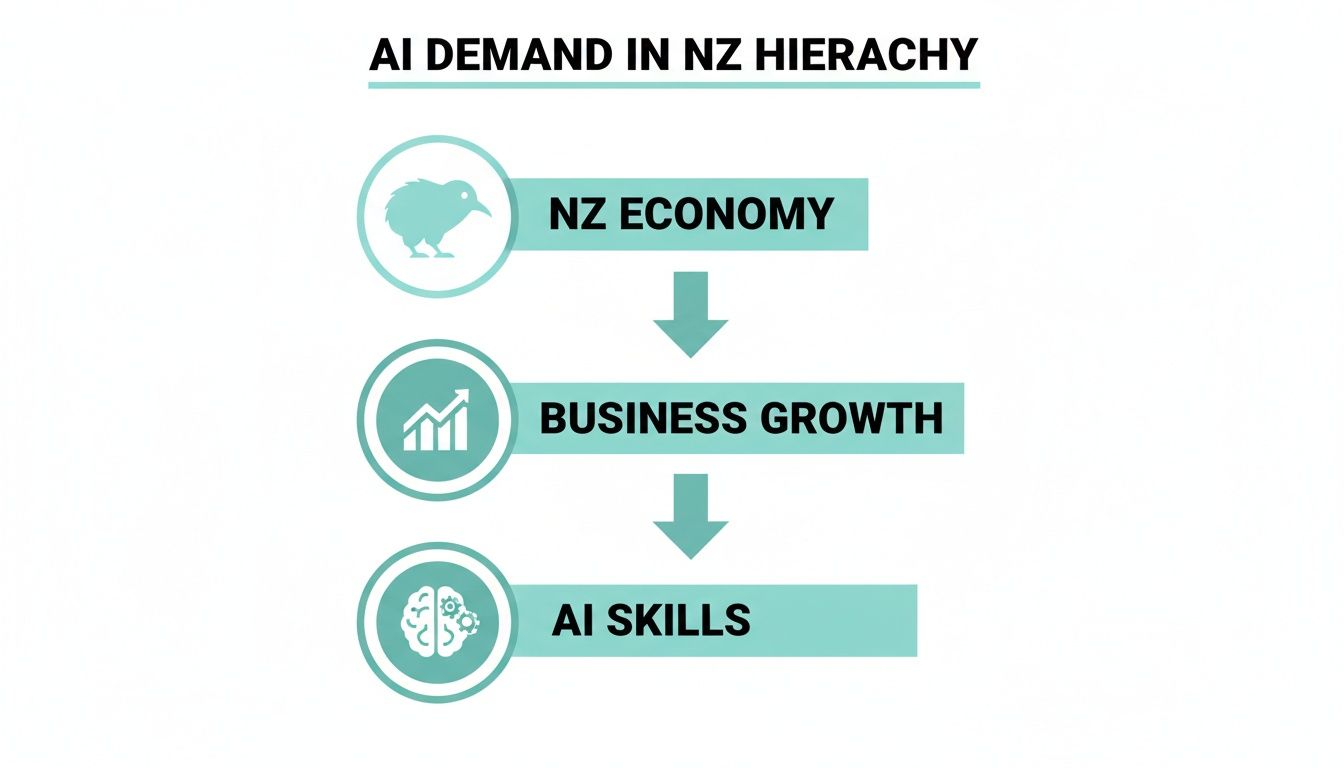
As you can see, building AI skills is the essential foundation that supports business growth, which in turn strengthens the entire national economy.
Short Courses and Micro-credentials
If you're looking for the express lane into the world of AI, short courses and micro-credentials are your ticket. These are tightly focused programmes, often lasting just a few weeks or months, designed to teach one specific skill or tool.
Think of them as professional development top-ups. A Kiwi hospitality manager might take a short course on using AI for dynamic pricing, while a tradie could grab a micro-credential in an AI-powered project management tool to streamline their jobs.
- Who they suit: Professionals wanting to add a specific AI skill to their toolkit without a massive time commitment.
- Key benefit: You get quick, targeted learning with an immediate, practical payoff. They’re perfect for solving a business problem you're facing right now.
Bootcamps and Diplomas
AI bootcamps and diplomas are a more serious commitment, offering a structured, deeper dive into the field. These programmes are typically full-time for several months and are all about getting you job-ready for a specific role in the tech industry.
When you're looking at these, you'll find that the core of many AI applications is Machine Learning, which is the science of training systems to learn from data without being explicitly programmed.
A diploma offers a similar level of practical depth but is usually spread over a longer period, like one or two years. It's also formally recognised within the New Zealand Qualifications Framework (NZQF). These options are for people who are serious about shifting into a dedicated AI or data career.
University Degrees
For those who want to be the architects of tomorrow's AI systems, a university degree remains the classic route. These programmes give you a rock-solid theoretical foundation in computer science, advanced mathematics, and data structures.
This is where you go to understand the 'why' behind the technology, not just the 'how'. A Bachelor's or Master's degree sets you up for roles in research, advanced AI development, and academia. They demand a significant investment of time and money but provide the deepest level of understanding you can get.
A university education in AI equips you with the first principles needed to innovate and create entirely new AI solutions, rather than just applying existing ones. It’s the difference between using a tool and building the tool itself.
Recognising that the traditional campus model doesn't work for everyone, New Zealand institutions are adapting. For example, Massey University is launching the country's first fully online undergraduate AI major in 2026. This is a huge step forward, allowing busy professionals or people in regional areas to gain that deep expertise without having to uproot their lives.
Comparing AI Course Types in New Zealand
To help you decide, here's a quick-reference guide that breaks down the main learning paths based on your goals, time commitment, and budget.
| Course Type | Best For | Typical Duration | Typical Cost (NZD) | Key Outcome |
|---|---|---|---|---|
| Short Course | Professionals needing a specific, targeted skill upgrade. | A few days to 8 weeks | $500 - $3,000 | Immediate application of a new tool or technique. |
| Micro-credential | Upskilling in a certified, industry-recognised area. | 3 - 6 months (part-time) | $2,000 - $5,000 | A formal, stackable qualification for your CV. |
| Bootcamp | Career changers wanting an intensive, job-focused path. | 12 - 24 weeks (full-time) | $10,000 - $18,000 | A portfolio of projects and job-ready practical skills. |
| Diploma | A structured, practical education for a specific tech role. | 1 - 2 years | $8,000 - $20,000+ per year | A formal qualification with deep vocational training. |
| University Degree | Aspiring researchers, developers, and AI innovators. | 3 - 4+ years | $8,000 - $25,000+ per year | Deep theoretical knowledge and research capabilities. |
Ultimately, this variety means that no matter your background or current role, there's a clear pathway available to build your AI knowledge. From a quick online workshop to a multi-year degree, the right choice depends entirely on what you want to achieve.
Leading Providers Shaping AI Education in New Zealand
So, you’ve got a good handle on the different types of AI courses out there. The next big question is, where do you actually go to study? New Zealand has a pretty diverse education scene, and each provider has its own unique character and focus.
Picking the right institution is just as critical as picking the right course. It dictates the kind of skills you’ll walk away with, the people you’ll connect with, and the overall flavour of your learning experience. Some are all about deep, theoretical research, perfect for future innovators. Others are geared towards practical, job-ready skills that Kiwi businesses need right now.
Let's break down the main players so you can find an AI course in NZ that feels right for you.
University Powerhouses
When you think of deep, academic learning, you think of universities. It's no different with AI. Institutions like the University of Auckland and the University of Waikato are home to some of the country’s leading computer science departments, driving a huge amount of local AI research.
If you’re aiming for a career in pure research, data science, or advanced machine learning engineering, this is your turf. University programmes are built on a rock-solid foundation of mathematics and computer science theory. The goal isn't just to teach you how to use AI models, but how to build the next generation of them.
- Best for: Future AI researchers, developers, and innovators who want a deep theoretical grounding.
- Focus: Foundational knowledge, advanced maths, and cutting-edge research.
Polytechnic and Vocational Training
Polytechnics, now mostly brought together under Te Pūkenga, take a much more hands-on, practical approach. Their courses are often designed hand-in-glove with industry, making sure what you learn directly matches what employers are looking for.
Think of it as the 'builder's' path. You learn how to take AI tools and apply them to solve genuine business problems. The focus might be on data analytics for a local retailer, automation for a manufacturer, or AI-powered digital marketing. For a business owner or a professional wanting to use AI on the job tomorrow, this practical lens is invaluable.
Polytechnics are fantastic at bridging the gap between abstract theory and the real-world needs of Kiwi businesses. They aim to produce graduates who can hit the ground running.
This makes polytechnics a solid option if you want a formal qualification that’s directly wired into the demands of the job market.
Specialist and Private Providers
Beyond the big public institutions, there’s a vibrant ecosystem of specialist providers offering intensive, career-focused AI training. A great example is the Institute of Data, which runs bootcamps specifically designed to fast-track people into data and AI careers.
These providers are nimble. They have their ears to the ground and maintain incredibly close ties with industry. You’ll often find their courses are taught by people working in the field, and the entire curriculum is built around creating a portfolio that proves you can do the job. It’s no surprise they’re a go-to for career changers who need to get up to speed quickly.
Corporate Training Initiatives
The learning doesn’t stop at traditional educators. Major tech companies are now a huge part of the AI skills puzzle. Global players like Microsoft and local heavyweights like Spark run their own training programmes and offer valuable certifications.
These programmes are typically centred on their own products and platforms - think Microsoft Azure AI or Google Cloud AI. For any business already invested in these ecosystems, this kind of training is a no-brainer. It gives teams the precise skills they need to make the most of the tools they already have, offering a direct line to better productivity and smarter ways of working.
How to Choose the Right AI Course for Your Goals
Investing in your education is a big decision, and picking the right AI course in NZ takes a bit more digging than just reading a shiny brochure. Think of it like hiring a skilled tradie; you wouldn't just take their word for it. You’d want to see their past work, check their references, and make sure they have the right tools for your specific job.
Applying that same level of care to choosing a course is crucial. You need to look past the sales pitch and get into the nitty-gritty of what the programme actually delivers. This means carefully evaluating the curriculum, the instructors, and the kind of support you’ll get along the way. Doing this homework ensures you make a smart choice that genuinely helps your career or business, giving you a real return on your investment of time and money.
Look for Practical, Hands-On Projects
Theory is important, but it’s in the doing that the real learning happens. A good AI course should get you building things, not just reading about them. A curriculum packed with hands-on projects is a massive green flag.
Why? Because working on real-world projects forces you to solve messy problems, debug code, and understand the nuances of applying AI in unpredictable situations. It’s the difference between knowing the recipe and actually knowing how to cook a great meal.
When you're looking at a course, ask to see examples of past student projects. Do they look impressive? Are they relevant to the industry you want to get into? A strong portfolio of completed projects is often far more valuable to an employer than a certificate alone.
Assess the Instructors' Real-World Experience
Who is teaching the course is just as important as what is being taught. The best instructors aren't just academics; they are practitioners who have been in the trenches and have recent, relevant industry experience.
An instructor who has actually built and deployed AI solutions for New Zealand businesses can offer insights you’ll never find in a textbook. They get the local market, understand the common challenges Kiwi companies face, and know the specific skills that are in high demand right now.
Look for instructors who are currently active in the field. Their experience provides a direct link between the classroom and the workplace, making your learning immediately more relevant and valuable.
Don't be shy about looking up the instructors on LinkedIn. Check their work history and see if their expertise lines up with your career goals. This simple step can tell you a lot about the quality of the education you're considering.
Verify the Career Support and Network
A good course shouldn't just end on the last day of class. Strong career support services can make a huge difference in helping you land your first role or apply your new skills effectively in your business.
This support can take many forms, from CV workshops and interview prep to networking events that connect you with local employers. Some of the best providers have dedicated teams that actively work to place their graduates into jobs. Having access to that kind of network is a powerful advantage. For SMEs, this might mean a course that offers follow-up consultations or connects you with a community of other business owners using AI.
You might also be interested in how AI training can be applied to solve specific, difficult business problems. For more on this, you can explore our article on using AI training for complex customer issues.
Your AI Course Evaluation Checklist
To make this process a bit easier, we've put together a checklist of what to look for when you're comparing different AI courses and providers here in NZ.
AI Course Evaluation Checklist
| Evaluation Criterion | What to Look For | Why It Matters |
|---|---|---|
| Curriculum Focus | A strong emphasis on practical projects and real-world case studies. | Proves you can apply skills, not just talk about them. This builds a valuable portfolio. |
| Instructor Profile | Tutors with recent and relevant industry experience in New Zealand. | Provides current, practical knowledge and valuable industry insights beyond theory. |
| Career Services | Dedicated job placement support, CV help, and networking opportunities. | Helps you translate your new skills into a tangible career outcome or business result. |
| Student Reviews | Independent reviews on platforms like Google, Course Report, or LinkedIn. | Offers unbiased feedback from past students on their actual experience and results. |
| Technology Used | Training on current, industry-standard tools and platforms (e.g., Python, Azure, AWS). | Ensures the skills you learn are in demand and directly applicable in the job market. |
Using these points as a guide will help you see past the marketing and find a course that truly delivers the skills and connections you need to succeed.
Moving Beyond Courses with Hands-On AI Training
For a lot of busy Kiwi small and medium-sized businesses (SMEs), the thought of signing up for a formal, time-consuming AI course in NZ just doesn't stack up. While those courses are great for building foundational knowledge, most business owners need to see results now, not get a PhD in data science theory. The good news? There’s a much more direct and faster way to get AI working for your business.
Think of it this way: you don’t need to be a qualified mechanic to drive a car. In the same vein, you absolutely do not need to be a data scientist to use AI tools effectively in your business.
For most SMEs, the real gold is in practical, on-the-job training that focuses on specific tools to solve immediate problems. This approach cuts straight to the chase, bridging the gap between abstract ideas and real-world results, delivering a return on your investment almost immediately.

From Theory to Tangible Results
Formal courses do a great job of explaining the 'why' behind AI, covering concepts like neural networks and algorithms. But for a trades business in Wellington or a café owner in Dunedin, the real question is 'how' - how can AI save me time and money this week?
This is where hands-on training completely changes the game. Instead of spending months on broad theories, you could spend just a few hours learning to set up an automated system that takes care of a specific, soul-destroying task for good.
Take a building company that sinks hours every week manually writing and sending out quotes. A traditional course might teach them the principles of Natural Language Processing. In contrast, direct, hands-on training would show them exactly how to implement an AI workflow that generates and sends those quotes automatically. That frees up the team to focus on the actual building work.
The goal of practical AI training isn't getting a certificate; it's getting things done. Success is measured by the immediate impact on your business's efficiency, customer service, and bottom line.
Identifying High-Impact Opportunities
The first step in this no-nonsense approach is figuring out where AI can make the biggest dent in your daily operations. For business owners already stretched thin, this is often the hardest part.
This is where a specialist partner like Automate AI comes into the picture. We work alongside Kiwi businesses to pinpoint these high-impact opportunities. We don't lead with technology; we start with your business problems.
Here are a few common pain points where targeted AI training delivers quick wins:
- Customer Service: Setting up an AI Voice Agent to answer calls 24/7, qualify leads, and book appointments. This means you never miss another customer enquiry, even after hours.
- Sales and Quoting: Creating automated workflows that instantly generate and send detailed quotes to potential clients, dramatically speeding up your sales cycle.
- Administrative Tasks: Building systems that automatically pull data from invoices and receipts, feeding it straight into your accounting software like Xero or MYOB.
Each of these solutions uses a specific set of AI tools. The training then becomes about learning how to use that tool for that job, which makes the learning curve way shorter and the results much faster.
The Power of Tailored On-the-Job Training
Unlike a generic online course, tailored training is designed around your team and your existing systems. It’s about slotting AI into the software you already use - like your CRM or accounting platform - not forcing you to learn a completely new way of working.
This type of training is all about building confidence and competence in your team. The goal is to turn your staff from AI sceptics into power users who are comfortable using these new tools every day. You can find out more about this process in our guide on AI training for NZ teams.
The process itself is straightforward:
- Identify the Pain Point: We find the most repetitive, time-wasting task in your business.
- Build the Solution: We set up the AI-powered workflow or tool to solve that specific problem.
- Provide Hands-On Training: We walk your team through exactly how to use and manage the new system.
This direct approach demystifies AI. It stops being some big, scary concept and becomes just another useful tool in your kit - like your accounting software or project management app. For SMEs in New Zealand, this practical path is often the smartest and fastest way to start reaping the rewards of AI today, without the delay and expense of a formal course.
Answering Your Top Questions About AI Courses in New Zealand
Deciding to jump into an AI course is a big move, and it’s completely normal to have a few questions buzzing around before you commit. You want to make sure you're making the right investment of your time and money.
To give you that final bit of clarity, let’s tackle some of the most common queries we hear from people just like you.
Do I Really Need a Coding Background to Get Started?
This is probably the biggest myth out there, and it stops a lot of talented people from even trying. The short answer is: absolutely not.
Sure, if you’re aiming for a deep-dive university degree in machine learning, you'll definitely need a solid foundation in programming and maths. But for most other pathways? They’re built for newcomers.
Many short courses, bootcamps, and even some diplomas are designed to start from scratch. Their goal is to build your AI literacy - helping you understand what AI can do for a business and how to use the tools already out there. If you're a business owner or manager, the focus is even less on the code and more on strategy and practical application, often using no-code platforms that require zero programming skills.
What’s the Typical Cost for an AI Course in New Zealand?
The price tag for an AI course in New Zealand can swing wildly, which is actually a good thing - it means there's an option for nearly every budget.
- An introductory online course to get your head around the basics might set you back just a few hundred dollars.
- More intensive, career-focused bootcamps typically sit in the $5,000 to $15,000 bracket.
- A formal graduate diploma from a university could cost domestic students anywhere from $8,000 to $20,000.
- For the deepest level of expertise, a full Master's degree can easily cost $30,000 or more.
The key is to think of the cost as an investment, not just an expense. Weigh it against the skills you'll walk away with and the real-world career or business opportunities it could unlock.
What Kind of Job Can I Expect to Land Afterwards?
The job you get is a direct reflection of the training you take. The career paths are incredibly diverse, mirroring how widely AI is being adopted across every industry.
If you graduate from a practical bootcamp or diploma, you'll be well-positioned for roles like an AI Specialist, Data Analyst, or Automation Consultant. These are hands-on jobs where you'll be using AI tools to solve concrete business challenges.
For business owners and managers, the outcome isn't a new job title. It's about gaining a new capability: the confidence to lead AI projects, spot opportunities for automation, make your team more efficient, and ultimately, drive real growth.
On the other end of the spectrum, those with a Master's or PhD are set up for highly specialised roles like AI Research Scientist or Senior Machine Learning Engineer - the people who build brand new AI systems from the ground up. As you start using AI, it’s also crucial to get your head around topics like AI data privacy and compliance in NZ to make sure you're using it responsibly.
How Long Does It Actually Take to Get Good at AI?
There's no single finish line for "proficiency" - it's a spectrum. How long it takes really comes down to what you're trying to achieve.
You can get incredibly good at using specific AI business tools in just a few weeks with focused, hands-on training. This is often the quickest way to see a tangible impact in your day-to-day work.
A full-time bootcamp can get you job-ready for a technical role in around 3 to 6 months. These programmes are intense by design, built to skill you up and get you into the industry fast.
But becoming a top-tier AI developer or researcher? That’s a much longer game. That path requires years of university-level study and a genuine commitment to lifelong learning to keep up with a field that's always evolving.
Ready to move from learning to doing? Automate AI specialises in hands-on training and implementation for Kiwi businesses, helping you apply AI to solve real-world problems and see an immediate return. Find out how we can help your business today.
Found This Helpful?
Book a free 30-minute discovery call to discuss how we can implement these solutions for your business. No sales pitch, just practical automation ideas tailored to your needs.
Automate AI Team
AI Automation Expert at AutomateAI