Choosing a Cyber Security Consultancy in New Zealand
A cyber security consultancy isn't just another IT service. It's a strategic partnership, like bringing in a team of specialist architects and engineers to fortify your company's digital presence. Their job is to find the weak spots, build robust defences, and have a solid plan ready for when things inevitably go wrong.
Why Your NZ Business Is a Bigger Target Than You Think
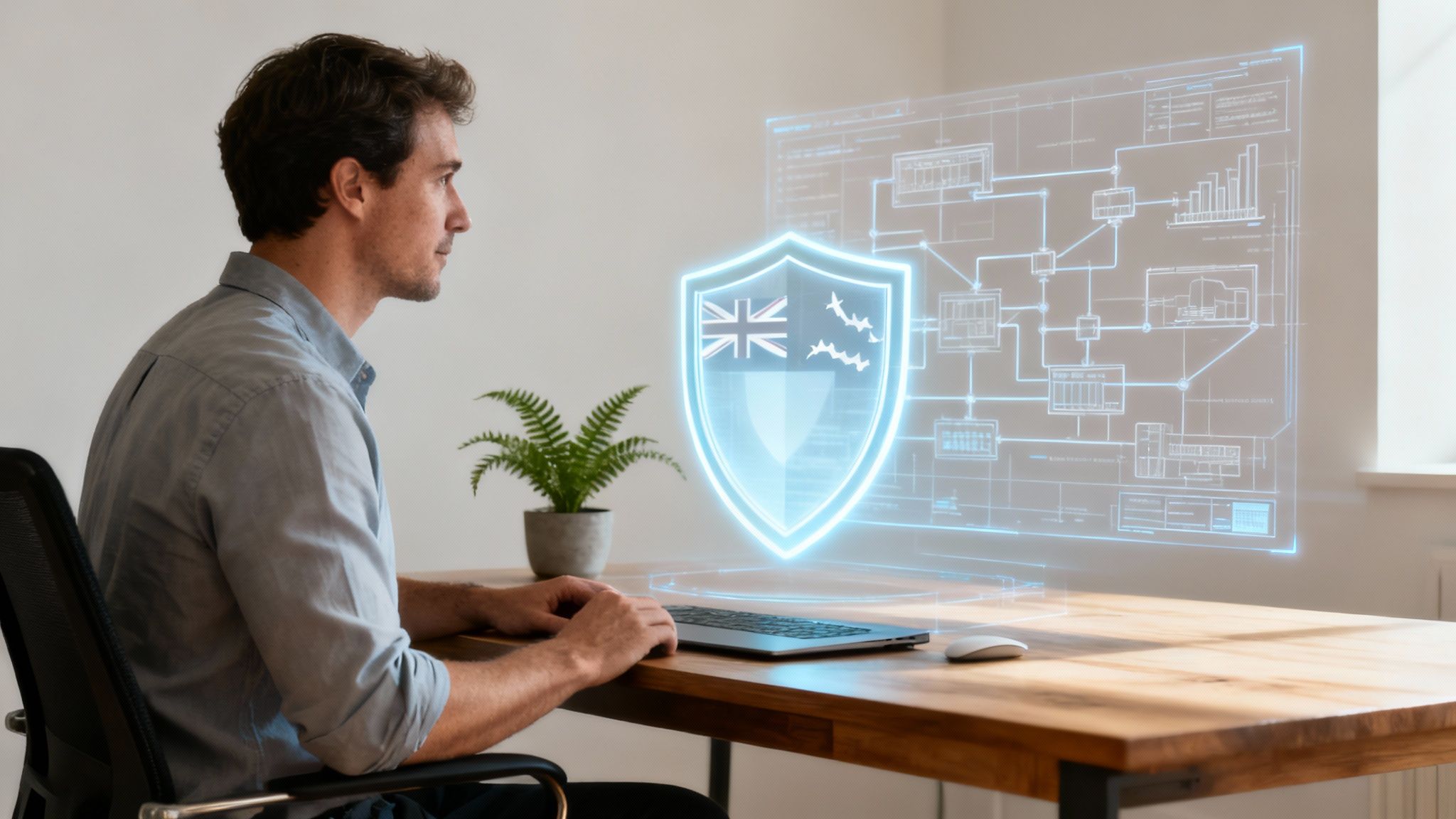
Many Kiwi business owners fall into the trap of thinking they're too small to be on a cybercriminal's radar. The hard truth is actually the opposite. Small and medium businesses (SMBs) are often viewed as soft targets precisely because they don't have the same security budgets or in-house experts as large corporations.
This isn't some far-off, abstract threat; it's a very real and growing problem right here in New Zealand. Cyber-attacks on local businesses are getting more common and far more sophisticated. If you're in retail, professional services, or manufacturing, the risk is especially high because of the valuable customer and financial data you hold. A breach isn't just about losing files; it's about losing trust, which can be much harder to get back.
Shifting From Defence to Resilience
Waiting to react after you've been hit is a surefire way to get into serious trouble. A cyber security consultancy helps you pivot from a purely defensive, reactive stance to a proactive state of genuine resilience. They stop you from just waiting for the alarm to sound and instead build a security framework that anticipates and neutralises threats before they can do any real damage.
This proactive approach breaks down into a few key activities:
- Finding the Gaps: A consultancy will perform a top-to-bottom assessment of your entire digital footprint. This covers everything from your network and cloud services right down to your team's laptops and phones, all to find where the cracks are.
- Building a Stronger Foundation: They put proper security measures in place, like robust firewalls, endpoint protection on all devices, and secure processes for handling data, to make your operations much harder to breach.
- Creating a Game Plan: If an incident does happen, having a clear, pre-planned response is critical. They'll create one for you so that you can take swift action to minimise the damage and get back online fast.
It's easy to see cyber security as just another business cost. A much healthier way to look at it is as a business enabler. Strong security protects your revenue, safeguards your brand, and gives you the confidence to grow and innovate without fear.
Security as a Competitive Advantage
Let's face it, data breaches make headlines all the time. Being able to show your customers that you take their security seriously can become a real point of difference. When people trust you with their information, they're far more likely to stick with you. That trust comes from knowing you’re doing everything you can to protect them.
Beyond customer loyalty, a secure environment simply lets your business run better. You can bring in new technology and improve your processes without constantly second-guessing the risks. This is particularly important here in New Zealand, where understanding data protection rules is non-negotiable. For a deeper look at this, you can learn more about data sovereignty and why NZ businesses need local AWS hosting in our detailed article.
At the end of the day, bringing in a cyber security consultancy isn't just about stopping bad things from happening; it's about creating the right conditions for good things to happen.
What a Top Cyber Security Partner Actually Does
When you bring a cyber security consultancy on board, you’re doing more than just buying a piece of software. You're hiring a team of digital detectives, strategic builders, and your own rapid-response crew. Their job is to cut through the complexity and move your business from a state of vague uncertainty to one of confident control.
Think of it like this: you wouldn't leave a commercial building without a structural assessment, reinforced locks, and a clear fire evacuation plan. A cyber security partner does the exact same thing for your digital presence.
The New Zealand cyber security market, valued at $2.5 billion in 2024, is expected to soar to $6.7 billion by 2032, growing at a staggering 13.1% each year. This isn't just a big-business issue. SMEs are the lifeblood of the NZ economy, and that makes them a prime target. In 2025, the average spend on cyber solutions is projected to hit US$79.83 per employee, which shows that Kiwi businesses are finally realising that cutting corners on security is an invitation for disaster.
Finding Your Weak Spots
Before you can build a strong defence, you have to know where the cracks are. A top-tier cyber security partner starts by acting like a building inspector for your digital assets, methodically hunting for any vulnerability a criminal could exploit.
This process isn't a single action but a combination of services:
- Risk Assessments: A deep dive into your people, processes, and technology to map out and prioritise potential security weak points.
- Vulnerability Scanning: Using specialised tools to scan your networks, servers, and apps for known security holes that need patching.
- Penetration Testing: Often called 'ethical hacking', this is where they simulate a real-world cyber-attack on your systems to see how your current defences hold up under pressure.
Imagine a local accounting firm in Christchurch that holds sensitive financial data for hundreds of clients. A vulnerability scan might reveal their client portal software is out-of-date, creating a back door for an attacker. Finding this weakness first allows them to patch the hole before a data breach completely shatters their reputation.
Building Your Digital Fortress
Once all the weak points are mapped out, the construction phase begins. This is where the consultancy helps you design and implement the right mix of technology, policies, and training to create a robust, multi-layered defence system. To get a full picture of what this involves, it's worth understanding the crucial role a cyber security consultant plays in this crucial stage.
Key building blocks often include:
- Network Security: Setting up and properly configuring firewalls and other controls to manage and monitor every bit of data flowing in and out of your business network.
- Endpoint Protection: Securing every device that connects to your network - laptops, servers, even mobile phones - with advanced threat detection and prevention software.
- Secure Cloud Setups: Making sure your cloud services, like Microsoft 365 or AWS, are configured to prevent data leaks and block unauthorised access. For a closer look at this, our guide on how AI-powered anomaly detection can act as your 24/7 financial guardian is a great resource.
A common mistake is thinking a single tool, like antivirus software, is enough. True security is about layering different defences, so if one fails, another is already in place to stop the attack.
To better illustrate how these services translate into real-world value, the table below breaks down some common consultancy offerings and what they mean for your business on a practical level.
Key Cyber Security Consultancy Services and Their Business Impact
| Consultancy Service | What It Means for Your Business | Example Scenario |
|---|---|---|
| Vulnerability Assessment | Identifies specific, exploitable weaknesses in your systems before attackers do. | A retail business discovers its e-commerce platform has a flaw that could expose customer credit card data, allowing them to fix it before a breach occurs. |
| Penetration Testing | Simulates a real-world attack to test how well your defences and response team perform under pressure. | An 'ethical hacker' successfully gains access to a company's internal network, revealing that employee security training needs to be improved. |
| Incident Response Plan | Creates a clear, step-by-step playbook to follow during a security breach, minimising panic and financial damage. | When hit by ransomware, the team immediately follows the plan to isolate affected systems and restore data from backups, avoiding a hefty ransom payment. |
| Security Policy Development | Establishes clear rules and guidelines for employees on how to handle sensitive data and use company technology safely. | A new 'password complexity' policy is implemented, significantly reducing the risk of accounts being compromised through simple brute-force attacks. |
| Cloud Security Review | Ensures your cloud services (like Microsoft 365) are configured correctly to prevent accidental data exposure or unauthorised access. | The review finds that a shared folder containing sensitive HR documents is publicly accessible, allowing the setting to be corrected immediately. |
This table gives you a snapshot of the tangible outcomes you should expect. A good consultancy doesn’t just sell you technology; they deliver peace of mind and measurable risk reduction.
Preparing for the Worst
Even the most heavily fortified castle needs an emergency plan. No defence is ever 100% foolproof, so one of the most critical jobs of a cyber security partner is preparing your business to respond decisively when - not if - an incident happens. The goal is simple: minimise the damage and get back to business as fast as possible.
This preparation generally focuses on two main areas:
- Incident Response Planning: Creating a crystal-clear, step-by-step guide that details exactly who does what during a security breach. This plan removes panic from the equation and ensures a coordinated, effective response.
- Data Backup and Recovery: Implementing and, just as importantly, regularly testing a robust backup system. This ensures that if your data is ever encrypted by ransomware, you can restore it without paying a single cent to the criminals.
Measuring the Real Return on Your Security Investment
It’s easy to fall into the trap of viewing cyber security as just another line item on your expense sheet. But that’s a costly mistake. The smart way to think about it is as a vital investment in your company’s future - one that pays clear dividends. The return on investment (ROI) here isn't just about dodging a financial bullet from a data breach.
Bringing a cyber security consultancy on board is really about building a more resilient business and opening up new opportunities. It's about protecting the reputation you've worked so hard to build, cementing customer trust, and giving you the green light to adopt powerful new tech like AI and automation without taking on unnecessary risk.
This threat isn't some far-off problem; it's right here on our doorstep and growing fast. In 2023, cyber security incidents across New Zealand jumped by 27%, with Auckland getting hit hardest, accounting for 41% of all reported cases. For businesses in places like Wellington, where we at Automate AI are based, the pressure is on. A massive 67% of businesses here increased their cyber security budgets in 2024, well above the national average of 52%. You can discover more about the growing New Zealand cyber security market to see how this affects SMEs.
The True Cost of a Breach vs Proactive Investment
When a Kiwi SME gets hit by a major cyber-attack, the financial bleeding doesn't stop with the initial incident. The aftermath often involves a painful mix of regulatory fines, legal bills, the cost of telling your customers what happened, and hefty invoices for system repairs. These direct costs alone can be enough to bring a growing business to its knees.
But often, it’s the indirect costs that do the most damage. Think about:
- Reputational Damage: Once you lose a customer's trust, it’s incredibly hard to earn it back. A public breach can stain your brand for years to come.
- Operational Downtime: Every single hour your systems are down is an hour of lost sales, lost productivity, and unhappy customers.
- Increased Insurance Premiums: After an incident, you can bet your cyber insurance costs will go up, adding a long-term financial headache.
This diagram shows how a consultancy works - they find your weak spots, build up your defences, and get you ready for whatever comes next.
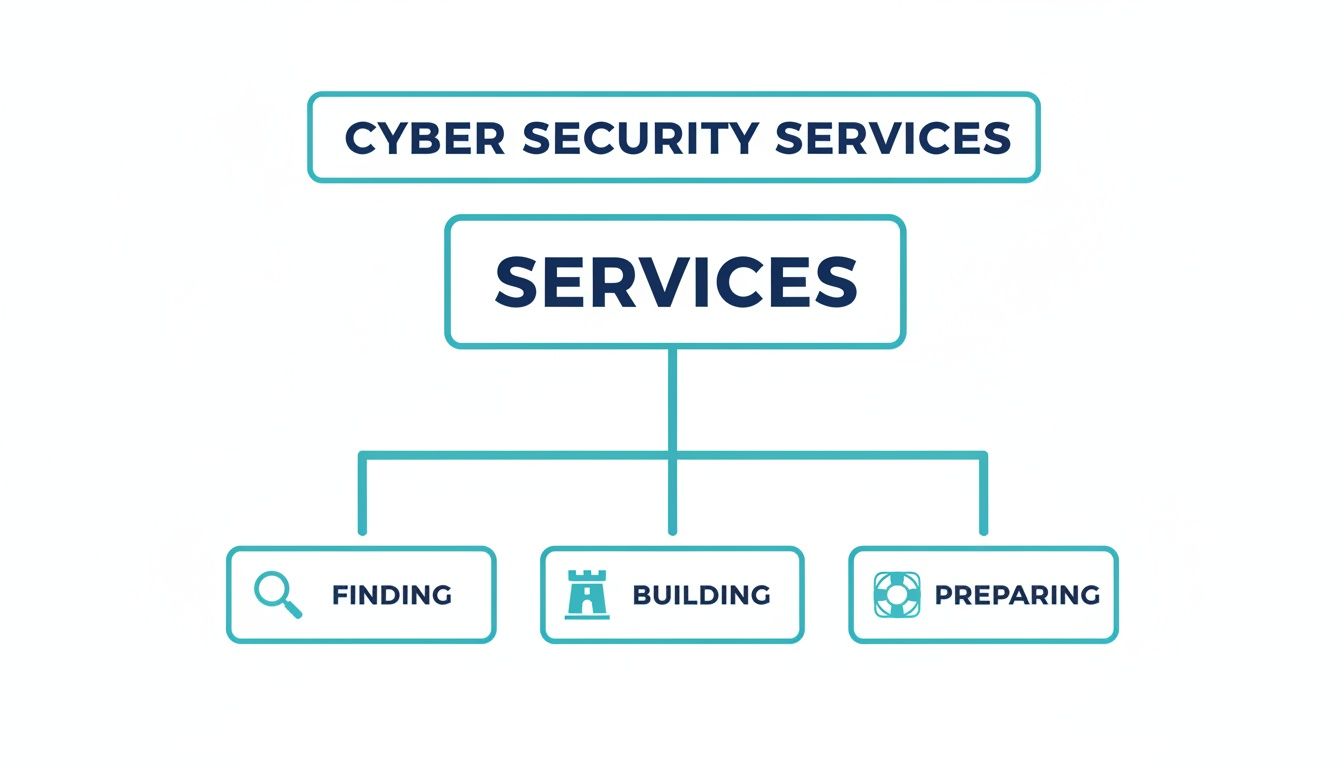
By zeroing in on these three areas, a consultant systematically lowers your chances of getting breached and softens the blow if the worst does happen.
When you weigh up the staggering average cost of a data breach for a New Zealand SME against the manageable, fixed cost of expert advice, the ROI is crystal clear. Being proactive about protection is one of the soundest financial moves you can make.
Beyond Defence: Strategic Advantages of Robust Security
Good security isn't just a defensive wall; it's a strategic tool that can actually drive growth. When you know your digital foundations are solid, you gain a few key advantages that put you ahead of the competition.
First, you can innovate without fear. Thinking about rolling out a new AI-driven workflow or connecting to a new cloud platform? A secure setup lets you chase those efficiencies without accidentally opening a backdoor for attackers.
Second, strong security becomes part of your brand. Customers are more switched on than ever about data privacy. Being able to show you’re serious about protecting their information is a massive selling point. It signals that you’re a professional, trustworthy business.
Finally, it guarantees you can keep the lights on. With a proper incident response plan and reliable backups, you can ride out a potential crisis and get back to business quickly, leaving less-prepared rivals scrambling. That kind of resilience is the ultimate return on your security investment.
How to Choose the Right Cyber Security Partner
Picking the right cyber security partner is one of the most critical decisions you'll make for your business. This isn't just about hiring another IT vendor; it's about inviting a strategic partner into your inner circle. A great partner becomes an extension of your team, translating technical jargon into clear business outcomes and helping you navigate a complex world with confidence.
Get this choice wrong, and you could be looking at wasted money, a dangerously false sense of security, and significant, unmanaged risk. To avoid that, you need a straightforward way to vet potential partners. It’s all about asking the right questions and looking past the sales pitch to see their real capabilities and whether they’re a good fit for your company culture.
Look for Proven Industry Experience
The cyber threats facing a law firm in Auckland are worlds away from those targeting a retail business in Queenstown. A one-size-fits-all approach to security just doesn't cut it. This is why your very first filter should be finding a consultancy that has deep, real-world experience in your specific industry.
They need to understand the unique data you handle, the specific regulations you’re bound by, and the common attack methods used against businesses just like yours. Don't be shy about asking for case studies or references from other companies in your sector. This isn't about ticking a box; it's about making sure they won't be learning the ropes on your time and at your expense.
An experienced partner brings invaluable context to the table. They can spot risks you haven’t even thought of and recommend security controls that are actually practical for your day-to-day operations.
Prioritise Local Knowledge and Support
When a security incident hits, the last thing you want is to be stuck on the phone with a support team on the other side of the world. A locally based cyber security consultancy offers a massive advantage. They're awake when you are and can provide on-the-ground support if a major crisis unfolds.
Even more importantly, a New Zealand-based partner will have a firm grasp of local compliance requirements.
This is especially true for New Zealand's Privacy Act 2020. A good local partner won't just help secure your data; they'll ensure your handling and reporting processes are up to scratch with the law, protecting you from hefty regulatory fines.
Local knowledge means they understand the specific threat landscape facing Kiwi businesses and can offer advice that is genuinely relevant to our market.
Evaluate Their Communication Style
Technical skill is the price of entry, but the ability to communicate clearly is what separates a good consultant from a great one. The best security partners can explain complex risks and technical solutions in plain English, always connecting the dots back to a tangible business impact.
During your initial chats, pay close attention to how they answer your questions.
- Are they drowning you in jargon? A partner who can't explain things simply might not understand them as well as they should, or worse, they'll struggle to align their work with your business goals.
- Are they listening more than they talk? They should be laser-focused on understanding your business challenges, not just pushing their off-the-shelf solutions.
- Do they talk about business outcomes? Their recommendations should always be framed around protecting your revenue, building customer trust, or enabling safer growth.
A partner who communicates well empowers you to make informed decisions. They help turn security from a confusing technical headache into a manageable business function. The table below gives you a simple checklist to guide you through this evaluation.
Finding a partner you can trust is crucial. Use these questions as a starting point to dig deeper and understand if a consultancy truly has the expertise and approach that fits your business.
Vendor Selection Checklist
| Evaluation Criteria | Key Question to Ask | Why It Matters |
|---|---|---|
| Industry Expertise | Can you provide case studies of your work with businesses similar to mine in New Zealand? | This verifies they understand your specific risks, compliance needs, and operational challenges, ensuring solutions are relevant and effective. |
| Local Presence | Where is your support team based, and what are their standard hours of operation? | Ensures you have access to timely support during NZ business hours, which is critical during an active security incident. |
| Communication Clarity | Can you explain the top three security risks for my business in simple, non-technical terms? | Tests their ability to translate complex issues into clear business language, which is essential for making informed decisions. |
| Incident Response | What does your incident response process look like, and what is our role in it? | Clarifies their preparedness and process, showing you exactly what to expect and what will be required of your team during a crisis. |
This checklist isn’t exhaustive, but it gives you a solid foundation for your conversations. By taking this structured approach, you can move beyond glossy brochures and find a true security partner who will help protect and grow your business for years to come.
Getting to Grips with Cyber Security Costs and Budgeting
For a lot of Kiwi business owners, the cost of bringing in a cyber security consultant feels like a total unknown. You know you need to protect your business, but figuring out what it’s going to cost seems like a massive hurdle. The good news? Effective security is more flexible and affordable than you might think.
The trick is to stop thinking of security as a random, scary expense and start treating it as a planned, sensible investment. A good consultant won’t just throw a single, non-negotiable price at you. Instead, they’ll work with you to find a solution that fits your actual needs and budget, making sure you’re not paying for things you don’t need.
Common Pricing Models Explained
Once you start looking into a cyber security consultancy, you'll quickly see a few common ways they structure their pricing. Each one suits a different kind of business and level of involvement, so understanding them is key to comparing quotes properly.
Most consultants in New Zealand will offer a mix of these options:
- Project-Based Fees: This is a straightforward, one-off cost for a specific job. Think of things like a full security audit, a penetration test to find weaknesses, or building out a proper incident response plan. It’s perfect when you have a particular issue to solve without needing a long-term commitment.
- Monthly Retainers: For ongoing peace of mind, a monthly retainer is the go-to model. This gives you consistent access to an expert for monitoring, advice, and regular security health checks. It’s a bit like having a security specialist on your team for a fraction of what a full-time hire would cost.
- Ad-Hoc Support (Pay-As-You-Go): Some firms offer hourly or daily rates for help when you need it. This can be handy for a bit of advice here and there, but it can quickly get expensive and unpredictable if you’re hit with a major problem.
What Shapes the Final Price Tag?
The cost isn't just a number plucked out of thin air; it’s directly tied to the size and complexity of your operation. A one-person business with a basic website has completely different security needs - and a different price point - than a 50-person company managing multiple cloud services and a heap of sensitive client data.
The real aim isn't to find the cheapest quote, but the one that delivers the most value. A smart, small investment in the right expertise now can save you from a financially crippling disaster later on, making it one of the best budgeting moves you can make.
A few key things will influence your quote:
- Business Size and Complexity: The more staff, devices, and software you're running, the more there is to protect.
- Data Sensitivity: A business handling private financial or health records naturally needs a much higher level of security than one that doesn't.
- Your Current Security Setup: If you’re starting from ground zero, the initial work will be more intensive than if you already have some basic security measures in place.
- Level of Service: A simple monitoring service will always be cheaper than a full-service package that includes 24/7 incident response and regular high-level strategy meetings.
Knowing these factors helps you have a much more meaningful chat with a potential security partner. It also opens the door to flexible solutions that can scale with you. For instance, understanding how a serverless architecture can offer cost-effective scalability for NZ startups shows that modern tech can be built to grow efficiently - and the same principle applies to security. Finding the right fit ensures you don’t overpay for services you don’t yet need or, worse, underinvest and leave your business wide open.
Weaving Security Into Your Everyday Business Tools
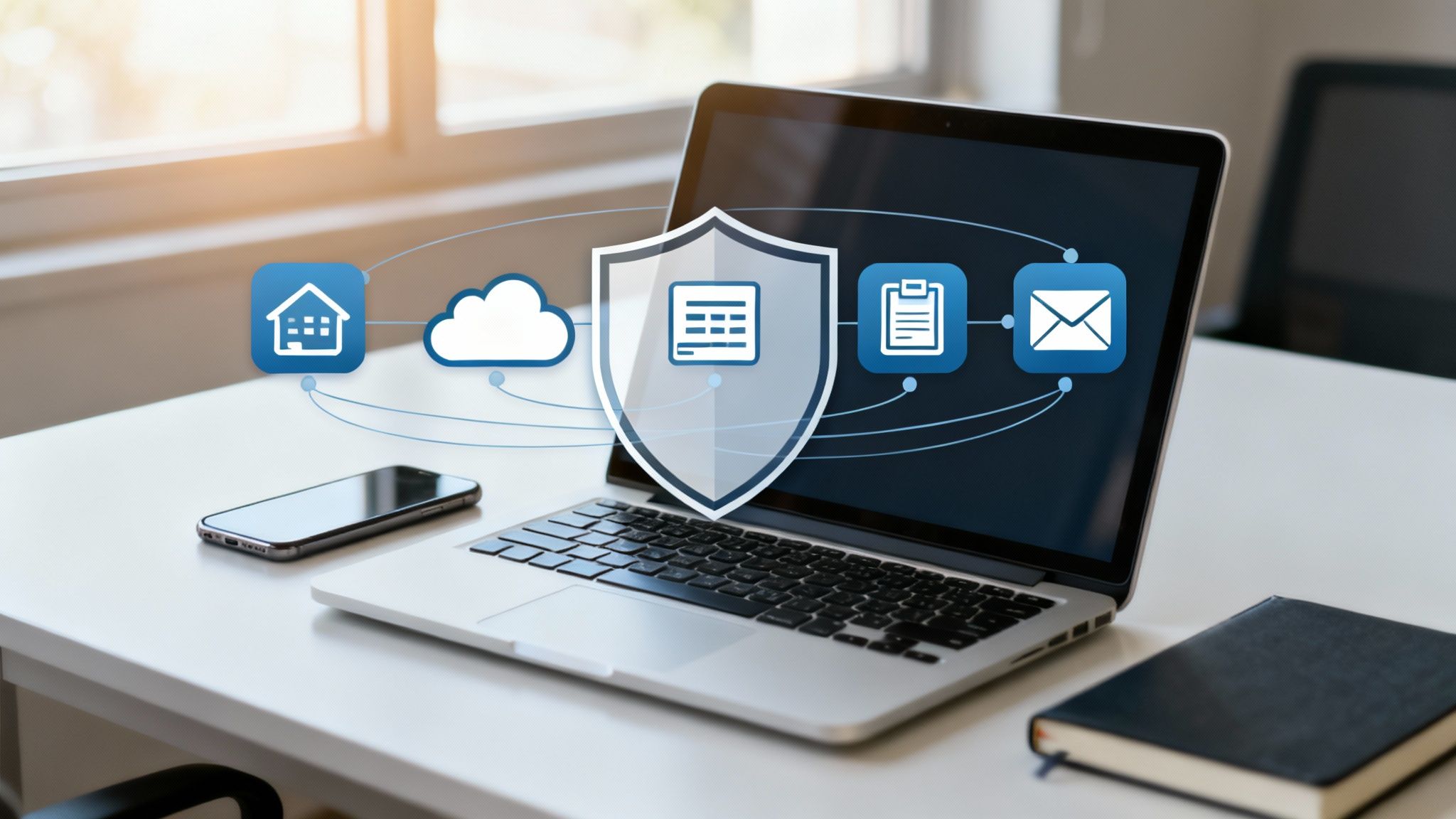
Real cyber security isn’t just another bit of software you install and forget. It's a way of thinking that needs to be stitched directly into the fabric of your daily operations. The best security measures don't get in your way; they work quietly in the background, protecting the essential tools you rely on every day.
For most Kiwi businesses, this means focusing on the software that runs your finances, communications, and customer relationships. Think about it: platforms like Xero, MYOB, and Microsoft 365 are the very heartbeat of your business, and they hold huge amounts of sensitive data that criminals would love to exploit.
This is where a cyber security consultancy comes in. Their job is to help you move beyond simply having these tools to using them securely. They’ll analyse how your data flows between systems, pinpoint potential weak spots in those connections, and put the right controls in place to lock everything down.
From Vulnerability To A Streamlined Advantage
Many business owners think that security and efficiency are at odds with each other, but that's a common misconception. When security is integrated properly, it actually makes your processes more robust and reliable. In the end, it often boosts productivity.
This synergy turns technology from a potential liability into a solid competitive advantage.
Let’s look at a few common scenarios for a New Zealand business:
- Secure Invoice Processing: You automate invoice data entry from emails straight into Xero, saving hours of manual work. A consultant makes sure that connection is encrypted and properly authenticated, stopping fraudsters from intercepting or changing financial details.
- Protected Client Communications: Using Microsoft 365 for client emails and file sharing is standard practice. A security review might add multi-factor authentication and data loss prevention policies, preventing sensitive documents from being accidentally shared outside your organisation.
- Safe Cloud Integrations: Connecting your e-commerce store to your inventory system is crucial for smooth operations. A security-first approach ensures this link is hardened against attacks that could steal customer data or mess with your supply chain.
By working with a consultancy, you build a digital environment where security and efficiency actually support each other, making your business both faster and safer.
Integrating Advanced Defences
Beyond locking down your standard business software, a good consultancy will also help you bring in more advanced layers of protection. As businesses lean more heavily on automation, making sure those automated systems are secure is critical. Our article on training AI on your compliance rules for automated accuracy dives deeper into how these principles work in practice.
Security isn't just about threats from the outside. A surprising number of data breaches start from within an organisation, whether it’s an honest mistake or something more deliberate. Properly configured systems help reduce these internal risks.
This is where specialised tools really prove their worth. Beyond basic firewalls and antivirus software, integrating systems like top insider threat detection tools can seriously strengthen your defences. These tools keep an eye out for unusual activity, helping you catch potential problems before they spiral into a full-blown crisis.
Your Cyber Security Questions Answered
Diving into cyber security for the first time naturally brings up a few questions. Getting straight answers is the best way to feel confident about your next move. Here are some of the most common queries we hear from Kiwi business owners.
Is My Business Too Small for a Consultancy?
This is a big one. There's a common belief floating around that cyber criminals only go after the big fish. The reality? Small and medium-sized businesses across New Zealand are often seen as softer targets, precisely because they might not have a dedicated security team. For an attacker, hitting ten small businesses can be just as lucrative as going after one large corporate.
Thinking your business is "too small to hack" is one of the riskiest assumptions you can make. Cyber threats aren't about size; they're about opportunity and vulnerability. A good cyber security consultancy doesn't offer a one-size-fits-all sledgehammer. Instead, they provide services that scale to your specific needs and budget, giving you protection that makes sense for you now and grows with you later.
It's not about whether you're big enough to be a target. It's about whether you're prepared enough to handle an attack. For any business today, proactive security is just a core function.
How Quickly Can We Get Protected?
You'd be surprised. Getting your business secured is usually a much faster and smoother process than most people imagine. While every business is different, the path to getting protected follows a pretty clear, structured plan.
It typically kicks off with a quick risk assessment to pinpoint your most glaring vulnerabilities. From there, we immediately focus on the foundational stuff - locking down your key accounts and strengthening the gateways into your network.
This step-by-step approach means you'll see real security improvements within days, not months. The aim is to get a solid defensive line in place fast, then build on that foundation. A full, comprehensive security plan can often be up and running in just a few weeks.
What’s the First Step to Improve Our Security?
Taking that first step is everything, and it’s way simpler than you might think. You don't need a huge budget or a degree in IT to start making a real difference. It all begins with a conversation.
Honestly, the single most practical thing you can do right now is get a handle on your specific risks. Every business is unique, so a generic, off-the-shelf solution is never going to be the right fit. A no-obligation chat with an expert is the perfect place to start.
This initial discussion will help you:
- Get a clear picture of where you stand by talking through the systems and data you can't live without.
- Pinpoint the actual threats you face, based on your industry and how you operate.
- Walk away with expert advice on the most effective first moves you can make.
It’s a simple action that turns security from a vague worry into a clear, manageable plan. You'll get the clarity and direction you need to protect the business you've worked so hard to build.
Ready to secure your operations and build a more resilient business? Automate AI specialises in providing strategic security and automation solutions that protect and streamline New Zealand businesses. Book a discovery call today to discuss your unique needs and get expert recommendations.
Found This Helpful?
Book a free 30-minute discovery call to discuss how we can implement these solutions for your business. No sales pitch, just practical automation ideas tailored to your needs.
Automate AI Team
AI Automation Expert at AutomateAI