Web Design Cost: A Practical Guide to Affordable NZ Websites
So, how much should you budget for a professional website in New Zealand? The honest answer is it can range from $1,500 for a basic site to well over $15,000 for a complex project. The final cost really boils down to who you hire and what you need your website to do.
Let's break down those numbers so you can budget with a bit more confidence.
How Much Does a Website Really Cost in NZ?
Trying to get a straight answer on web design costs can feel like you're chasing shadows. Many agencies and freelancers are notoriously vague, often hitting you with the classic "it depends" when all you want is a ballpark figure. That lack of transparency makes it incredibly tough for Kiwi business owners to plan a budget or compare their options fairly.
The truth is, your investment will hinge on the path you take. You could go with a freelancer for a more budget-friendly approach, a full-service agency for their all-hands-on-deck support, or a modern subscription service that bundles everything into one predictable monthly fee. Each one has its own price tag and perks.
Your Options at a Glance
To give you a clearer starting point, let's break down the typical investment ranges for a standard small business website in New Zealand. This should help you get a feel for the financial commitment tied to each type of provider.
- Freelancers: Often the most wallet-friendly choice for simpler projects. They're a great middle-ground, giving you professional skills without the hefty overheads of a big agency.
- Traditional Agencies: This is the premium option. Agencies bring a full team to the table - designers, developers, and strategists - making them perfect for complex, custom websites that need deep expertise.
- Subscription Services: A modern, all-in-one approach. Services like Rapid Site roll the design, development, hosting, and ongoing maintenance into a single, predictable monthly payment after a small setup fee.
Here's a quick comparison to put things into perspective.
Typical Web Design Investment in NZ at a Glance
This table gives you a snapshot of the estimated upfront and ongoing costs you can expect for a standard small business website from different providers here in New Zealand.
| Provider Type | Typical Upfront Cost (NZD) | Typical Monthly or Annual Cost (NZD) | Best For |
|---|---|---|---|
| Freelancer | $2,000 - $6,000+ | $50 - $150+ per month | Small businesses or startups needing a professional but straightforward site. |
| Web Design Agency | $8,000 - $15,000+ | $150 - $500+ per month | Established businesses needing a complex, custom-built, or high-traffic site. |
| Subscription Service | $500 - $1,500 | $150 - $300+ per month | Small businesses looking for a high-quality site with predictable, all-inclusive costs. |
As you can see, the different paths have very different financial footprints.
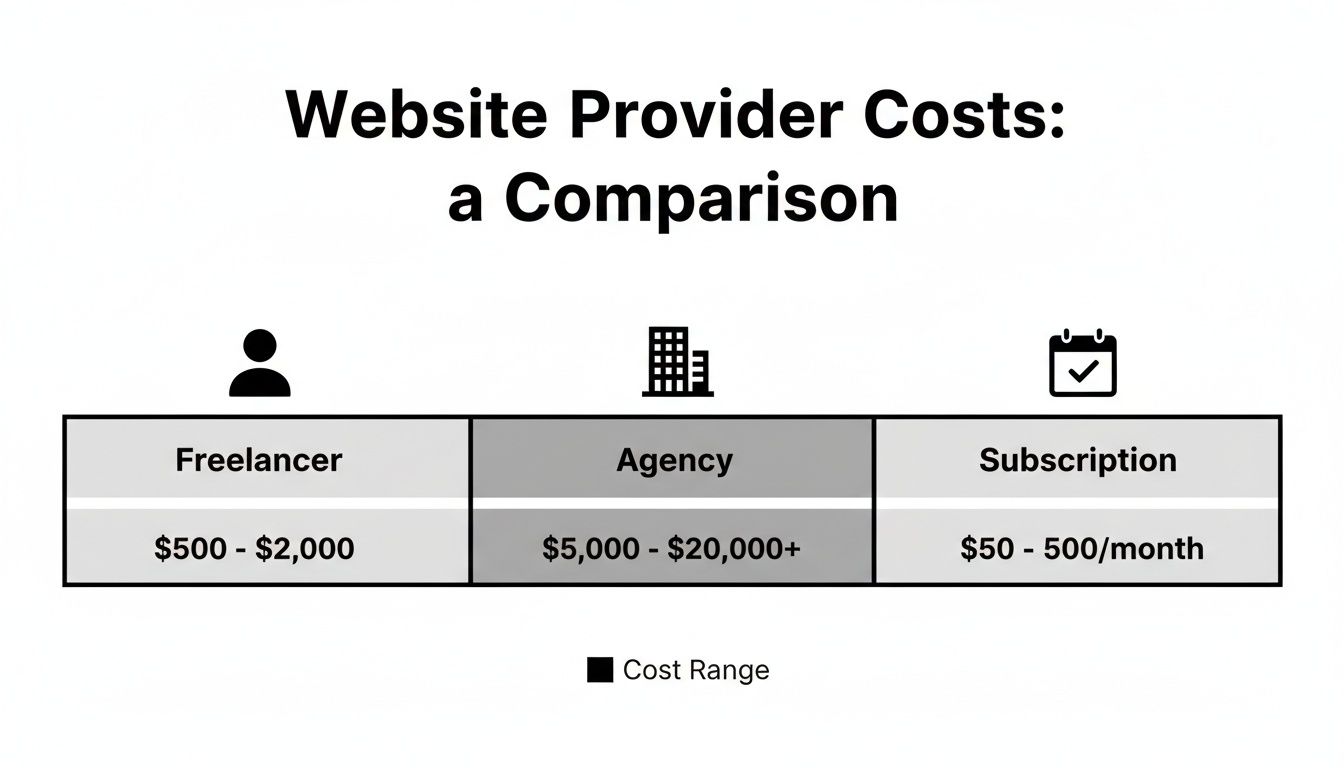
While agencies require the biggest upfront investment, subscription services offer the lowest barrier to entry and the most predictable long-term costs. This is why they're becoming a popular choice for small businesses that need to manage cash flow without cutting corners on quality.
Getting your head around these fundamental differences is the first step toward making a smart decision for your business. For a clear breakdown of our all-inclusive plans, you can check out Rapid Site's transparent pricing.
The Key Factors That Drive Your Website's Price

It’s easy to get confused when you get three different quotes for a new website and they're all wildly different. But the variation isn't random. It really just comes down to a few core components that determine the final price tag.
Think of it like building a house. The final cost depends entirely on the size, the complexity of the design, and any custom features you decide to include. Understanding these key drivers helps you see exactly where your money is going, so you can decide what’s absolutely essential for your business and what can maybe wait.
Let’s break down the main elements that build up the total cost of a website project.
Custom Design vs Templates
One of the first, and biggest, decisions that shapes your budget is the design approach. Are you building from a unique blueprint, or are you starting with a pre-made foundation?
- Templates: These are pre-designed layouts that offer a super quick and affordable way to get online. While you lose a bit of creative freedom, they're perfect for Kiwi businesses that need a professional look without a massive upfront investment. A lot of the heavy lifting is already done.
- Custom Design: This is the bespoke suit of the web world. A designer crafts a unique website from scratch, built to perfectly match your brand and guide your customers on a specific journey. Naturally, this process takes a lot more time and skill, which is why it comes with a much higher price.
For a plumber in Hamilton, a clean, professional template is probably all they need to get the phone ringing. But a boutique clothing brand in Queenstown? They'll almost certainly need a custom design to create an online shopping experience that’s as unique and memorable as their products.
The Scale of Your Website
This one's pretty straightforward: the sheer size of your website is a direct cost driver. More pages mean more work. It’s more design, more development, more content to write, and more pages to optimise for search engines.
A simple five-page "brochure" site is worlds away from a 50-page website with multiple service categories and a regularly updated blog.
Just like building a house, a one-bedroom apartment is always going to be cheaper to build and furnish than a five-bedroom family home. Every extra page is like another room that needs to be planned, built, and decorated, which directly adds to the hours required and, therefore, the final web design cost.
The scale of functionality is just as important. In New Zealand's competitive market, a straightforward brochure-style website for a tradie or consultant might cost between NZD $1,000 and $3,000. However, adding e-commerce functionality can quickly push that figure to NZD $5,000 to over $20,000 due to the complexity of shopping carts, payment systems, and inventory management.
Specialised Functionality
Beyond your standard pages, any special features or tools you need will add to the final price. These are the things that allow your website to do stuff for your business, rather than just displaying information.
Some common examples include:
- E-commerce Functionality: The ability to sell products online is a big one. It requires setting up product pages, a secure checkout process, payment gateway integration, and a system for managing stock.
- Booking Systems: If you’re a consultant, personal trainer, or run an accommodation business, an integrated calendar and booking system is a must-have, but it adds a whole layer of technical complexity.
- Membership Portals: Creating exclusive content areas for paying members involves setting up user registration, secure login systems, and figuring out how to manage different access levels.
Each of these features requires specialised development, rigorous testing, and solid security measures, all of which contribute to the final cost. It's also worth remembering how a faster website can improve the user experience of these features; you can learn more about the importance of site speed for conversions. Making sure these tools are quick and responsive is crucial for keeping your customers engaged and converting them into sales.
Choosing Your Web Design Partner: DIY vs. Freelancer vs. Agency
Once you’ve got a handle on what goes into web design costs, the next big question is: who’s actually going to build your site? This decision is just as critical as the budget itself, because it shapes the quality, timeline, and the whole experience. For Kiwi business owners, there are really three main paths you can take.
Think of it like getting from Auckland to Wellington. You could drive yourself, hire a private driver, or book a seat on a luxury coach. Each option gets you there, but the cost, speed, and comfort level are worlds apart. Let's break down your options so you can figure out the best route for your business.
The DIY Route
Platforms like Wix, Squarespace, and Shopify have made it easier than ever to get a website online. With their drag-and-drop tools and ready-made templates, you don’t need to know a lick of code. Their biggest selling point? A low monthly fee.
But there’s a massive hidden cost here: your time. What looks easy on the surface can quickly turn into a frustrating time-sink as you battle with clunky layouts, design limitations, and confusing SEO settings. You might save a few dollars upfront, but the hours you pour into it are hours you're not spending on your actual business. Plus, getting a DIY site to look truly professional and rank well on Google is a real uphill battle for a non-expert.
Hiring a Freelancer
For many small businesses, hiring a freelance web designer is the perfect middle ground. You get a professional's expertise and a custom result without the hefty price tag of a full-scale agency. A good freelancer can build you a polished, effective website that’s built just for you.
The main drawback? Reliability and capacity. You’re relying on one person, so their availability can be a bottleneck. If they get sick, take a holiday, or land a bigger client, your project can grind to a halt. Getting ongoing support can also be tricky, as you're completely dependent on their schedule.
For a lot of growing NZ businesses, deciding between a freelancer and an agency is a tough call. A freelancer might quote you NZD $1,500 to $4,000 for a standard small business site, which feels much more manageable than an agency’s typical NZD $5,000 to $15,000+ starting price. This gap is exactly why you need to scrutinise what’s included in the quote - from ongoing maintenance to SEO.
Engaging a Web Design Agency
When you’ve got a big, complex project, a web design agency is the top-tier choice. Agencies bring a whole team to the party: designers, developers, copywriters, and SEO specialists. This team approach means an expert handles every single part of your site, delivering a high-end, strategic asset for your business.
Of course, that level of expertise doesn't come cheap. Agencies have significant overheads, and their quotes reflect that, making them the most expensive option by far. For many small Kiwi businesses, that price point is simply out of reach. It can be useful to understand the different business models, for instance, by learning how agencies get web design clients.
Ultimately, the right choice boils down to your goals, your budget, and how much of your own time you’re willing to invest. To see how different NZ businesses got it right with a modern, all-inclusive approach, check out some of our client success stories.
Looking Beyond the Initial Quote: The Hidden Costs of a Website
That first quote from a web designer? It's a big number, but it's almost never the final number. So many Kiwi business owners get a surprise when they realise there are ongoing costs needed to keep their site online, safe, and actually doing its job.
Thinking the initial build fee is the total cost is a bit like buying a car and completely forgetting about petrol, insurance, and the WOF. It just won’t run for long. To budget properly, you have to look past launch day. Let's pull back the curtain on these often-overlooked costs so you can plan for the long haul and avoid any nasty surprises.
The Essentials: Domain, Hosting, and Security
Before anyone can even visit your website, it needs a few fundamental things in place. These aren't optional extras; they're the recurring costs that form the very foundation of your online presence.
- Domain Name Renewal: This is your website's address, like
yourbusiness.co.nz. You have to renew it every year, which usually costs between $30 and $50 annually here in New Zealand. - Web Hosting: Think of this as the piece of land your website is built on. You're renting space on a server to store all your website's files. Basic shared hosting might start around $25 per month, but for a site with more traffic or features, you could be looking at $100+ per month.
- SSL Certificate: This is what gives you the little padlock in the browser bar, telling visitors your site is secure and their data is encrypted. Some hosting plans throw in a free one, but for a business, especially an e-commerce site, a more robust certificate can cost $100 or more per year.
These three are the absolute basics. Without them, your website simply doesn't exist online.
Ongoing Maintenance: Your Website’s WOF
A website isn't a one-and-done deal. You can't just set it and forget it. Just like your car needs a regular service to run smoothly and stay safe on the road, your website needs ongoing maintenance to perform at its best. Think of it as your website's Warrant of Fitness.
Website maintenance isn't just a "nice-to-have" - it's a critical, preventative measure. It means regularly updating software, scanning for malware, backing up your data, and squashing any bugs that pop up. Skipping this leaves your site wide open to hackers and performance problems, which can kill your reputation and scare off customers fast.
Here in NZ, maintenance plans from agencies or freelancers typically run anywhere from $60 to over $200 a month, depending on how much support you need.
Planning for Future Growth
Your business changes, right? It grows, pivots, and evolves. Your website needs to be able to do the same. Many business owners forget to budget for these future updates when they're first starting out.
For example, you might launch with a simple site showcasing your services, but six months down the track, you decide you want to start selling products online. Or maybe you need to add a sophisticated booking system or a private client portal. Every one of these additions requires more design and development work, and that comes with a price tag.
Building a little room in your budget for these future enhancements means your website can grow with your business, not hold it back.
A Smarter Approach to Web Design Costs
Let's be honest, navigating the traditional web design world can be a real headache. After wrestling with confusing quotes, vague timelines, and the inevitable discovery of hidden fees, many Kiwi business owners are left wondering if there’s a better way.
The good news? There is.
The old model of waiting weeks for a quote, followed by months of development, is quickly becoming a thing of the past. A more efficient, transparent, and results-focused approach is here, one that gets you online faster without the financial guesswork and budget blowouts.
Introducing The Rapid Site Model
At Rapid Site, we’ve built our entire process around transparency and real value. We combine the power of our advanced AI platform with the critical eye of human experts to build high-performance websites in days, not months.
We’ve done away with the unpredictable, multi-thousand-dollar agency quotes for a simple, clear-cut model. It starts with a one-off $990 setup fee, followed by a predictable monthly plan that covers absolutely everything else.
This isn’t about cutting corners; it’s about working smarter. Our process eliminates the endless back-and-forth and administrative bloat that inflates agency costs, and we pass those savings directly on to you.
What Does All-Inclusive Really Mean?
When we say “all-inclusive,” we genuinely mean it. Our monthly plans are designed to give you total peace of mind, bundling all the essentials that agencies so often bill for separately. Think of it as the difference between buying a complete house-and-land package versus getting a surprise bill for the plumbing and wiring after you've moved in.
Our goal is to make professional web design accessible and predictable. By bundling everything from hosting and maintenance to SEO and content into one plan, we remove the financial risks so you can focus on running your business, confident that your website is in expert hands.
So, how does our model stack up against the old way of doing things? Here’s a quick breakdown of what’s packed into a Rapid Site plan compared to what you’d typically pay for with an agency.
Rapid Site Plan vs Traditional Agency Pricing
| Feature or Service | Rapid Site All-Inclusive Plan | Typical Agency Added Cost |
|---|---|---|
| High-Performance Hosting | ✅ Included in monthly fee | $50 - $150+ per month |
| Ongoing Maintenance & Security | ✅ Included in monthly fee | $100 - $250+ per month |
| Professional SEO-Ready Copy | ✅ Included in setup | $100 - $250+ per page |
| On-Page SEO Foundations | ✅ Included in setup | $1,000 - $3,000+ upfront fee |
| Analytics (GA4) Setup | ✅ Included in setup | $500 - $1,500+ setup fee |
| Satisfaction Guarantee | ✅ Standard with every site | Varies (often not offered) |
As you can see, the value is clear. Those extra costs that quietly creep up with a traditional agency are completely covered from day one with Rapid Site, making your total web design cost far more manageable and predictable.
Built For Performance From The Ground Up
A great website is so much more than a pretty design. It needs to be fast, secure, and easy for your customers to find on Google. That's why every single Rapid Site website is built on a modern React framework – the very same technology used by global giants like Netflix and Facebook.
This powerful foundation ensures your site loads at lightning speed, giving your visitors a smooth, frustration-free experience that keeps them engaged. A faster site doesn't just feel better to users; Google actively rewards it with better search rankings. We build every site to score 95+ on Google PageSpeed, a benchmark that many traditionally built websites really struggle to hit.
From the moment your site goes live, it’s already optimised for success. We handle the on-page SEO, create professional content that speaks to your audience, and even submit your new site to Google for you. It’s a complete, results-driven partnership designed to help your NZ business thrive online, all for a predictable, transparent cost.
Answering Your Top Web Design Cost Questions
Right, let's get into the questions we hear all the time from Kiwi business owners. Clearing these up will help you set a realistic budget, know what to expect, and move forward without any guesswork.
How Much Should a Small Business in NZ Really Budget for a Website?
This is the big one, isn't it? While there’s no single price tag that fits everyone, there's a solid ballpark figure to keep in mind. For a professional website that actually brings in leads, built by a freelancer or small agency here in New Zealand, you should be looking at a budget between NZD $2,000 and NZD $6,000 for the initial build.
That price usually gets you a well-designed, multi-page site that looks great on mobile and is set up to turn visitors into customers. But remember, that's just for the design and development. The ongoing costs for things like hosting, maintenance, and security are typically extra.
A more modern approach, like a subscription model, can be easier on the cash flow. Some services charge a one-off setup fee of around NZD $990, then a predictable monthly fee that bundles all those ongoing costs together. For many small businesses, this is a lifesaver - it keeps the upfront investment low and gets rid of surprise bills down the track.
Can I Save a Bit of Money by Supplying My Own Content?
You absolutely can. If you can provide your own well-written copy and high-quality images, most designers will happily trim their quote. It saves them a huge amount of time, and they can pass that saving on to you.
But there's a big "if" here. The quality of your website is only as good as the content on it. A stunning design can fall completely flat if it’s filled with clunky text or blurry, amateur photos. Your words need to be persuasive, and your images need to look professional - not to mention everything has to be optimised for Google so people can actually find you.
This is exactly why all-inclusive packages often include professional copywriting. It just guarantees the final product is polished and works as a whole, saving you the stress while ensuring top-notch quality.
It really boils down to a classic trade-off: time versus money. Writing your own content saves you cash, no doubt. But it demands a serious time commitment and a real knack for writing for the web. If words aren't your thing, paying a professional copywriter is an investment that pays for itself many times over in customer engagement and better search rankings.
Why Are Some Website Quotes So Wildly Different?
It's completely normal to get quotes that are thousands of dollars apart. The difference usually comes down to three things: scope, process, and overheads. A hefty quote from a big city agency probably includes a deep-dive strategy session, multiple design concepts to choose from, and a whole team of specialists - strategists, designers, developers, SEO experts. They also have expensive offices to pay for.
On the flip side, a lower quote from a freelancer or a small studio is often more streamlined. They might start with a premium template to speed things up and have a much more direct process. With lower overheads, they can offer more competitive pricing.
The trick is to look past the final number and scrutinise what’s actually included. A quote is a statement of work, not just a price. The gaps in cost are often filled by value-adds like built-in SEO, mobile optimisation, content creation, and how much custom work is involved.
Is It Better to Pay a One-Off Fee or a Monthly Plan?
This choice really comes down to your business's cash flow and how you like to handle your expenses. Both models have their pros and cons.
- One-Off Fee: Paying a lump sum upfront means you "own" the website files outright. The catch is that you're then on the hook for separate, often unpredictable, bills for hosting, security updates, plugins, and any changes you want to make later.
- Monthly Plan: This approach bundles everything - hosting, security, maintenance, and support - into one fixed, predictable payment. It makes budgeting a breeze and protects you from unexpected costs.
For many Kiwi businesses, a hybrid model strikes the perfect balance: a manageable setup fee to get the ball rolling, followed by a simple monthly plan that covers all the essentials. This gives you financial predictability without needing a massive chunk of capital upfront, making a high-quality website accessible from day one. It's not just web design where pricing models can be tricky; people often wonder about how much professional headshots cost, comparing traditional photographers with new AI solutions.
Ready for a high-performance website without the confusing quotes and hidden fees? Rapid Site combines AI efficiency with expert Kiwi oversight to deliver a complete, SEO-ready website in days. Get started with a predictable plan that covers everything from hosting to maintenance. Learn more about our smarter approach.
Found This Helpful?
Book a free 30-minute discovery call to discuss how we can implement these solutions for your business. No sales pitch, just practical automation ideas tailored to your needs.
Automate AI Team
AI Automation Expert at AutomateAI