A Guide to Business Automation for Kiwi SMEs
Let's be honest, we all have those jobs in our business that are repetitive, a bit boring, and soak up way too much time. Think about chasing invoices, sending out standard quotes, or answering the same five customer questions every single day.
Business automation is simply about using smart technology to take care of these tasks for you. It's like building a digital team member that works 24/7, doesn't need coffee breaks, and handles the monotonous work so your real team can focus on what they do best: growing your business.
What Exactly Is Business Automation?

Forget the technical jargon for a second. The easiest way to think about business automation is to imagine setting up an 'autopilot' for your day-to-day operations. Instead of a staff member manually typing up and sending every quote, a system does it instantly. Instead of someone spending their afternoon chasing late payments, an automated reminder goes out on schedule.
This is all made possible by technology, often with a sprinkle of Artificial Intelligence (AI), that follows rules you set. It’s not about replacing your amazing people; it's about getting rid of the administrative grind that gets in their way.
The real magic happens when you let technology handle the predictable, rule-based work. This frees your team to pour their energy into complex problem-solving, creative thinking, and building genuine customer relationships - the things that actually push the business forward.
When your people aren't stuck in a cycle of repetitive tasks, they have the headspace to focus on what truly matters: looking after your customers and spotting new opportunities.
A Game-Changer for Kiwi SMEs
For a lot of businesses here in New Zealand, especially the small and medium-sized ones, the pressure is on. We're all feeling the pinch from rising operational costs and finding good staff can be a real challenge. In this environment, every hour of an employee's time is pure gold.
This is where business automation stops being a 'nice-to-have' and becomes a serious strategic move.
By putting key processes on autopilot, Kiwi SMEs can:
- Operate 24/7: Your business can keep working long after you've locked up for the night, answering queries and booking appointments while you sleep.
- Slash Human Error: Automated systems don't have off-days or make typos. This means far greater accuracy for crucial jobs like invoicing and data entry.
- Boost Efficiency: What used to take hours of manual work can now be done in seconds, letting you achieve more without needing to hire more people.
It’s a practical way to level the playing field, giving smaller Kiwi companies the power to deliver the kind of polished, instant service that was once the domain of huge corporations. You're turning those frustrating bottlenecks into smooth, efficient workflows.
A big part of making this happen is using tools like AI agents. If you're curious, you can find out more about how they handle specific tasks in our detailed guide on what AI agents are.
What Automation Actually Does for Your Business
Let's move past the buzzwords. Business automation delivers real, measurable results that show up on your bottom line. It’s about closing the gap between how things have always been done and reaching a new level of performance. For Kiwi businesses, the return on investment isn't some far-off promise; it's a daily reality.
Think about your accounts team. Right now, they might be spending a chunk of their week chasing down late payments. With automation, invoices are sent, processed, reconciled in Xero, and followed up on - all without anyone lifting a finger. That simple change massively improves cash flow and frees up your finance people to focus on strategy, not admin.
Or picture your sales team. Instead of starting their day with a cold list, they walk in to a calendar already filled with qualified appointments. Why? Because an AI Voice Agent was working overnight, answering inbound calls, qualifying leads, and booking meetings. You stop missing opportunities. That's the practical power of automation.
Get More Done, With Fewer Mistakes
One of the first things you'll notice is how automation stamps out human error in those repetitive, but critical, tasks. We’ve all seen it: a typo in a quote, a wrong number in a spreadsheet, a missed step in client onboarding. These small mistakes can snowball into big problems.
Automated systems, on the other hand, do the job with perfect consistency, every single time. This doesn't just improve the quality of your output; it creates huge efficiency gains. A recent survey shows just how widespread this is becoming: in 2025, an incredible 82% of New Zealand organisations are now using AI. Even more telling, 93% of those businesses report that AI has made their workers significantly more efficient. This proves automation is the key to getting more done without burning out your team. You can dive into the full findings in the 2025 AI-driven productivity report for New Zealand.
Suddenly, that administrative drag is gone, freeing your team up to handle more important work and giving you a real competitive edge.
Make Your Customers Genuinely Happier
In a crowded market, the quality and speed of your customer service is often the one thing that sets you apart. Automation helps you deliver instant, accurate, and helpful responses, day or night.
It could be a simple automated booking confirmation that gives a customer peace of mind, or an AI agent that answers common questions after you’ve all gone home. Either way, your business looks more professional, reliable, and on top of things.
When you automate routine customer interactions, you're not replacing the human touch - you're guaranteeing a consistent, high-quality standard of service that builds trust and loyalty. People feel looked after when their needs are met instantly.
This translates directly into better business outcomes:
- Faster Response Times: Leads are followed up in minutes, not hours, dramatically increasing your chances of making the sale.
- 24/7 Availability: Your business is always 'open', ready to help customers and capture opportunities outside of the 9-to-5 grind.
- Personalised Communication: Smart systems can send tailored follow-ups and reminders, making every customer feel like they’re your only priority.
The Impact on Your Bottom Line: Real Cost Savings
At the end of the day, it all comes down to the numbers. A smart investment in automation pays for itself surprisingly quickly by cutting costs from several angles. First, you reduce the sheer number of hours your team spends on low-value admin, which is a direct saving on your wage bill.
It goes deeper than that, though. By eliminating errors, you avoid the hidden costs of fixing mistakes. By processing invoices faster, you get paid sooner, which improves your cash flow and financial stability. Best of all, you can scale your operations and take on more work without having to proportionally increase your headcount.
These aren't just one-off savings. They are small, daily wins that add up over time. We explore this in more detail in our guide on the compound benefits of automation. This is exactly how smart Kiwi businesses are building more resilient, efficient, and profitable operations.
Finding the Right Automation Solution for Your Business
Picking the right automation tool is a bit like choosing the right tool for a job on the worksite. You wouldn’t use a sledgehammer to hang a picture, right? In the same way, the best automation solution for your business comes down to the specific problem you're trying to fix. For most New Zealand businesses, the first step is simply figuring out where your biggest operational headaches and bottlenecks are.
Instead of one single product that does everything, automation is really a toolkit of different solutions, each one designed to tackle a specific challenge. Whether you need to manage a complex client journey from start to finish, offer 24/7 customer support, or just get on top of your finances, there’s a specialised tool built for that task.
The trick is to match the technology to your unique business needs.
Unpacking the Main Types of Business Automation
To help you figure out what's what, let's explore three powerful types of automation that are delivering huge value for Kiwi businesses right now. We'll look at what they actually do, the problems they solve, and which kinds of businesses get the most out of them.
Which Automation Solution Is Right for Your Business?
To make it even clearer, here’s a quick breakdown comparing the different automation solutions, the common problems they solve, and the NZ business types that stand to benefit the most.
| Automation Type | What It Does | Ideal For (NZ Business Type) |
|---|---|---|
| AI Workflows | Manages multi-step processes from beginning to end, connecting different apps and automating tasks like client onboarding or lead follow-ups. | Service-based businesses like consultancies, marketing agencies, and trade services that rely on flawless process management. |
| AI Voice Agents | Acts as a digital receptionist, answering calls 24/7, booking appointments, answering FAQs, and qualifying leads with a natural voice. | Businesses where the phone is a critical lead source, such as real estate agencies, healthcare clinics, and hospitality venues. |
| AI Document Processing | Intelligently reads documents like invoices and receipts, extracts key data, and automatically enters it into accounting software like Xero. | Any business dealing with lots of paperwork, including construction companies, e-commerce stores, and professional services. |
Each of these tools addresses a different part of the business puzzle. Now, let’s dive a little deeper into how they work in the real world.
1. AI Workflows for End-to-End Processes
Think of an AI Workflow as a digital project manager that never sleeps. It's designed to take a complete, multi-step process off your hands, connecting all the different apps you use and making sure nothing ever gets missed. It's perfect for things like onboarding a new client, nurturing a sales lead all the way through the funnel, or managing a job from the initial quote to the final invoice.
Let's say a new lead fills out the form on your website. An AI workflow can instantly spring into action and:
- Add the contact to your CRM.
- Fire off a personalised welcome email.
- Create and assign a follow-up task for a sales team member.
- Ping your team a notification on Slack or Microsoft Teams.
This ensures every single lead is handled consistently and immediately, completely removing the risk of human error or things falling through the cracks. For service-based businesses like consultancies, marketing agencies, and tradies who live and die by their processes, this is an absolute game-changer.
2. AI Voice Agents as Your Digital Receptionist
An AI Voice Agent is essentially your 24/7 front-of-house professional. It answers your phone with a surprisingly natural, conversational voice and can handle a huge range of customer enquiries without you or your team lifting a finger. It can answer common questions, qualify new leads by asking the right questions, book appointments straight into your calendar, and even transfer calls to the right person when needed.
Imagine never missing another customer call because you’re on-site, tied up in a meeting, or it’s after hours. An AI Voice Agent is there to capture every single opportunity, making sure your customers always get an immediate, professional response.
This is invaluable for any business where the phone is a critical source of new work. Think of real estate agents needing to book viewings, medical clinics managing patient appointments, or restaurants and cafes handling reservations. It transforms your phone line from a potential bottleneck into an efficient, round-the-clock lead generation machine.
As this infographic shows, these specific solutions are all about driving broader business goals like efficiency and growth.
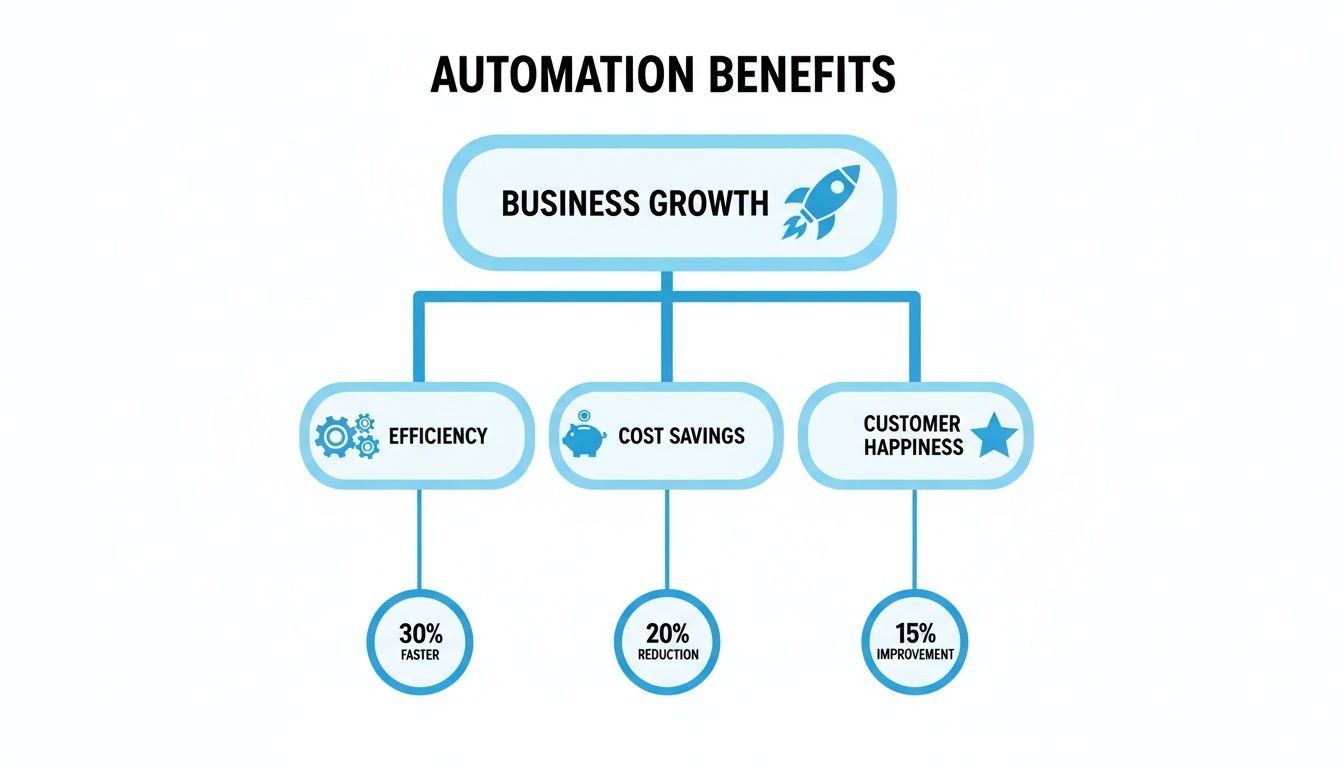
Ultimately, putting tools in place for efficiency, cost savings, and happier customers are all pathways that lead to sustainable business growth.
3. AI Document Processing for Financial Admin
Finally, AI Document Processing tackles one of the most tedious administrative burdens of all: manual data entry. This technology can actually read and understand documents like invoices, receipts, and forms. It intelligently pulls out key information - like invoice numbers, GST, amounts, and due dates - and feeds it directly into your accounting software, such as Xero or MYOB.
This completely eliminates the mind-numbing task of having someone sit there and manually type data from paper or PDFs into a spreadsheet. Research shows that businesses can reduce the time spent on operational tasks by about 30% just by implementing this kind of AI.
It’s an ideal solution for any business that drowns in paperwork. We're talking construction companies processing hundreds of supplier invoices, e-commerce stores managing receipts, or professional services firms tracking expenses. By automating this crucial but painfully time-consuming job, you don't just save countless hours - you also dramatically improve the accuracy of your financial records.
How to Implement Automation in Your Business

Jumping into business automation is far more straightforward than most people think. You don't need to be a tech wizard or have a massive IT department on standby. With the right partner, the whole process is managed for you, and it’s often possible to have a working solution up and running in just a few weeks.
The key to a successful project isn't trying to automate everything at once. Far from it. The best approach follows a proven, practical roadmap designed to get you the biggest wins with the least amount of disruption. We stick to a simple three-step process - Discover, Build, and Launch - that ensures your first steps are confident and effective.
Phase 1: Discover Your Best Opportunities
The first phase is all about investigation. Before we even think about technology, we need to do a thorough audit of your current operations to find the hidden gems - the most valuable opportunities for automation. Think of it as a health check for your business, pinpointing exactly where manual work is causing the most friction.
This discovery process involves mapping out your key workflows from start to finish. We hunt for the biggest bottlenecks, the most mind-numbing repetitive tasks, and the areas where human error keeps popping up. The goal here is to identify the “quick wins” - those high-impact, low-complexity processes that will deliver an immediate and very noticeable return on your investment.
A common mistake is aiming for a massive, complex automation project from day one. The smarter approach is to start small. By targeting a single, painful bottleneck first, you prove the value quickly and build momentum for what comes next.
Finding these initial targets is crucial. Often, it’s a simple process like automating quote follow-ups or streamlining invoice processing that saves the most time and gives you the biggest efficiency boost right away.
Phase 2: Build and Integrate Your Solution
Once we've locked in the best opportunities, the build phase begins. This is where we design and create your custom automation, then connect it with the business tools you already use every single day. A seamless integration isn't just a nice-to-have; it's non-negotiable for a successful project.
Your new system needs to talk to your existing software, whether that’s your:
- CRM: Like HubSpot or Pipedrive for managing customer relationships.
- Accounting Software: Like Xero or MYOB for handling your financials.
- Communication Tools: Including Slack or Microsoft Teams for team alerts.
- Calendars: Such as Google Calendar or Microsoft Outlook for booking appointments.
This integration ensures data flows smoothly between all your platforms without anyone having to manually copy and paste information ever again. The result is a unified system where your new automation workflows feel like a natural extension of your existing setup, not some clunky add-on.
Phase 3: Launch, Train, and Monitor
The final phase is the launch, where we roll out the newly built automation to your team. A great launch isn't just about flicking a switch. It involves clear communication and hands-on training to make sure everyone understands how the new system works and, most importantly, how it’s going to make their jobs easier.
After going live, we move into ongoing monitoring and support. We track key performance indicators (KPIs) to measure the real-world impact of the automation, from time saved and costs cut to errors eliminated. This data gives you hard evidence of the return on investment.
For Kiwi businesses looking to get started, this structured approach takes out all the guesswork. You can learn more about how to pinpoint those initial opportunities in our guide on creating your 30-day automation quick wins roadmap. It’s a clear path to making business automation a powerful part of your everyday operations.
See Business Automation in Action Across NZ Industries
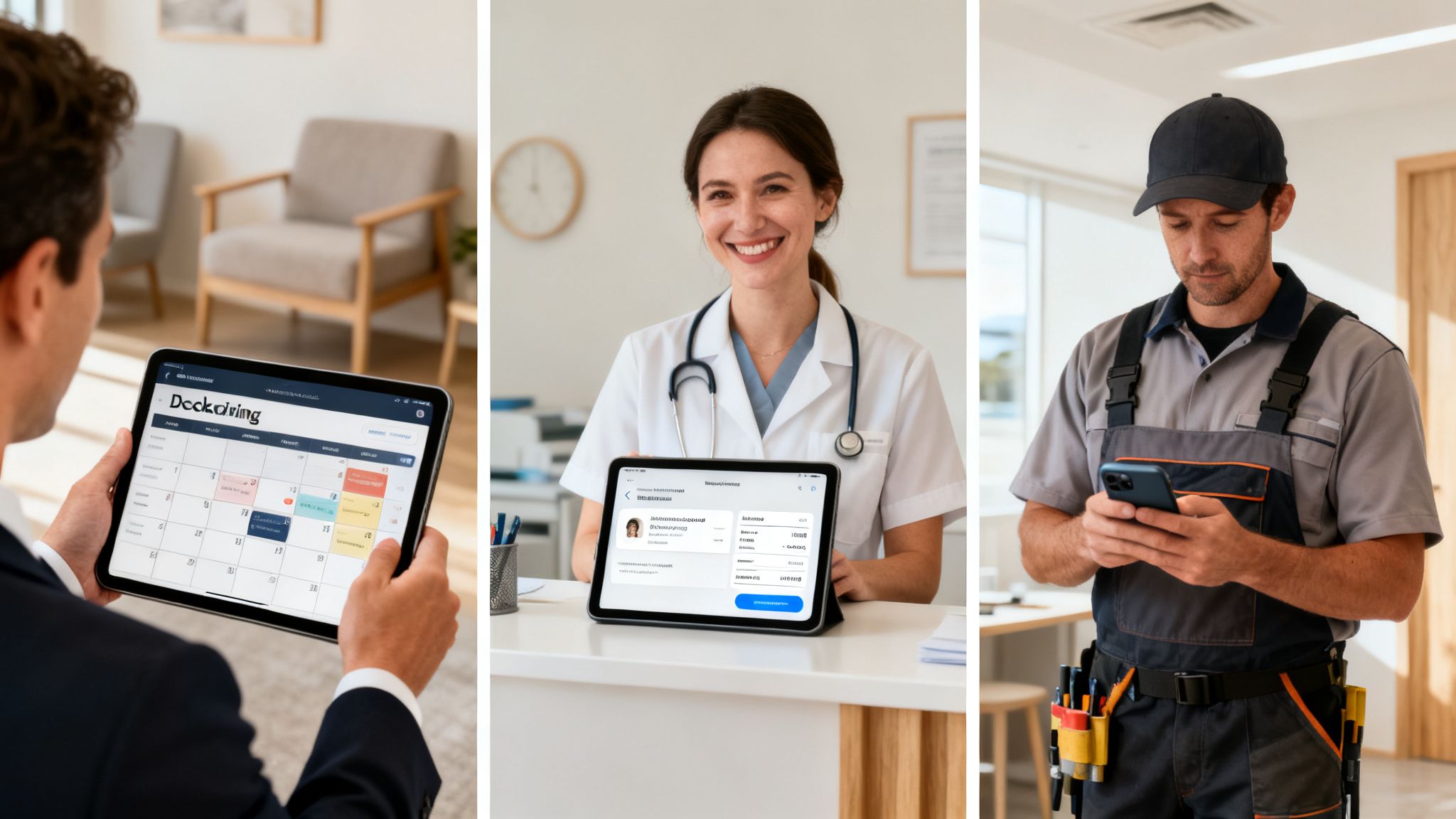
Theory is one thing, but seeing business automation working in the real world is where it all clicks. The true power of these tools comes alive when they’re put to work solving the specific challenges that Kiwi businesses face every day.
From managing a flood of client enquiries to keeping cash flow healthy, automation is already delivering practical, measurable results across New Zealand. Let’s look at a few scenarios from different sectors to see how it plays out on the ground.
Real Estate Agencies Winning Back Time
If you work in real estate, you know that an agent's time is everything. Every minute spent on admin is a minute you're not with clients or closing deals. One of the biggest time-sinks? Managing the constant stream of enquiries from online listings and then trying to schedule viewings.
This is a classic job for an automated lead management workflow. Here’s how it works:
- Instant Qualification: An enquiry comes in, and the system immediately sends a response with a few key questions: budget, preferred location, finance pre-approval. No more manual back-and-forth.
- Automatic Scheduling: Based on the answers, the system offers up available viewing times, letting the prospective buyer book a slot that drops straight into the agent’s calendar.
- Seamless Follow-up: After the viewing, a thank-you message and a request for feedback are sent automatically. This keeps the lead warm without the agent lifting a finger.
Suddenly, agents are freed from endless phone tag and email chains. They can start their day with a calendar full of qualified appointments, ready to focus on what they do best: selling property.
Healthcare Clinics Reducing Admin Overhead
In New Zealand’s healthcare clinics and medical practices, the pressure is always on. You need to provide top-notch patient care while wrestling a mountain of admin - from bookings and intake forms to reminders and follow-ups. This manual workload is often overwhelming and can lead to expensive no-shows.
Automation in a clinic isn’t about replacing the human side of care. It’s about clearing away the administrative noise so practitioners can give their full attention to patients.
An integrated patient management system can be a game-changer. It sends out appointment reminders via SMS and email, which dramatically cuts down no-show rates. New patients can fill out their intake forms securely online before they even arrive, with all that info populating their file automatically. That means less time in the waiting room and fewer data-entry mistakes at the front desk.
We've seen first-hand how healthcare practice automation can save over 15 hours weekly.
Trade Services Improving Cash Flow
For tradies and construction businesses, getting paid on time is the lifeblood of the operation. Yet the whole process - creating quotes, sending invoices, and chasing up late payments - is a huge time-drain that hits cash flow directly. A delay in getting paid can mean a delay in buying materials for the next job.
Automating the quoting and invoicing process completely changes the game. A trade services business can set up a system to fire off professional quotes instantly based on job details. Once the work is done, the invoice is created and sent just as fast.
But here’s the crucial part: the system can also follow up on unpaid invoices with a series of polite but firm reminders. This consistent follow-up ensures you’re never forgotten, which massively speeds up payment times and boosts the financial health of the business. It’s no surprise that 48% of New Zealand's mid-sized businesses now see this kind of automation as their top tech investment priority, as shown in a recent MYOB report on the AI payoff for NZ firms.
Finding the Right Automation Partner in New Zealand
Picking the right company to help you with business automation is a big deal. Get it right, and you’ll have a partner who feels like a genuine extension of your team, actively helping you grow and become more efficient. But get it wrong, and you could be looking at endless delays, a wasted budget, and a system that just doesn’t do what you were promised.
What you’re really looking for is a partner, not just a piece of software. A lot of the do-it-yourself automation tools out there seem great on the surface, but they often come with a steep learning curve and require a fair bit of technical know-how. Before you know it, you’re hiring a specialist just to run the thing, which completely defeats the purpose of saving time and money.
Why You Absolutely Need NZ-Based Support
Let's be realistic. When something goes sideways or you need to adjust a process, you can't afford to wait 24 hours for an email response from a support team in a completely different time zone. When your daily operations are on the line, you need help now, from people who get what it’s like to do business here.
A New Zealand-based partner brings more to the table than just convenient office hours. They understand the unique hurdles and advantages Kiwi businesses have. They know the local regulations and have experience integrating with the tools we all use, like Xero and MYOB. That local knowledge is priceless.
What to Look for in a Great Partner
As you start talking to different providers, keep these key things in mind. They’ll help you separate the good from the great and make a decision you won’t regret.
- Bank-Level Security: Your data is everything. You need to be confident that your partner uses top-tier, enterprise-grade security and encryption to keep your business and customer information safe. Ask them directly about their data protection practices.
- Real Kiwi Success Stories: Don't just take their word for it. Ask to see proof of their work with other New Zealand businesses, ideally ones in your industry. A solid provider will have no problem sharing case studies that show they've tackled the same kinds of challenges you're facing.
- Clear, Scalable Pricing: You should know exactly what you’re paying for, with no nasty surprises. The best partners offer pricing that can grow with you, so you can start with a few essential workflows and expand as your business and automation needs get bigger.
- They Stick Around: Watch out for companies that set things up and then disappear. A true partner is in it for the long haul, handling everything from the initial planning and building to ongoing support and monitoring to make sure you keep getting value.
The real measure of a partner is how focused they are on your return on investment. They should be just as obsessed as you are with achieving measurable results - like hours saved or costs reduced - and give you clear reports that prove their worth.
Ultimately, you want to find a team that’s as committed to your success as you are. Look for a partner who can get you up and running quickly, provides fantastic local support, and is dedicated to helping you see real, tangible results from your investment.
Common Questions About Business Automation
Dipping your toes into business automation can feel like a big leap, and it’s completely normal to have a few questions swirling around. Over the years, we’ve found that most Kiwi business owners have the same worries when they first start looking into it.
So, let's cut through the noise and tackle those big questions head-on.
Is Business Automation Too Expensive for a Small Business?
This is, without a doubt, the number one concern we hear. There’s a persistent myth that automation is a game reserved for massive corporations with bottomless budgets. The reality today is completely different. Modern automation platforms are incredibly scalable, with affordable starting points built just for small and medium-sized businesses right here in New Zealand.
You don’t need a massive upfront investment. Many providers, including ourselves, work on a subscription model. This means you can start small, perhaps with just a single workflow that tackles your biggest headache, for a manageable monthly fee. It’s the perfect way to prove the value, see a return on your investment almost immediately, and then expand as your business grows.
Think of it less like a huge capital expense and more like hiring a super-efficient digital assistant for a fraction of the cost of a person.
Will Automation Make My Staff Redundant?
This is another big one, and it comes from a deep-seated fear about technology taking jobs. But here's the truth: business automation is about augmentation, not replacement. It's a tool to free your talented people from the mundane, repetitive tasks that eat up their day, not to make their roles obsolete.
By automating the daily grind - things like manual data entry, chasing up overdue invoices, or answering the same five customer questions over and over - you give your team their time back. You empower them to focus on the things that truly matter: thinking creatively, solving complex problems, and building fantastic relationships with your customers.
Essentially, it elevates them from admin doers to strategic thinkers.
How Much Technical Skill Do I Need to Get Started?
Honestly? None at all. It’s a common misunderstanding that you need to be some sort of tech wizard to get automation up and running. When you work with a full-service partner, that simply isn’t true. The right partner takes care of all the tricky stuff for you.
They’ll handle everything from mapping out your current processes to building, integrating, and maintaining the solution. You bring the expert knowledge of your business and its pain points; they bring the technical know-how to build the fix. The whole process is managed for you, so you can just enjoy the benefits of a smoother, more efficient operation without any technical headaches.
Ready to see how Automate AI can tackle your specific business challenges? We handle all the complexity so you can get back to doing what you do best. Let's start a conversation about your automation goals today.
Found This Helpful?
Book a free 30-minute discovery call to discuss how we can implement these solutions for your business. No sales pitch, just practical automation ideas tailored to your needs.
Automate AI Team
AI Automation Expert at AutomateAI


