Finding the Right IT Consultants in Auckland for Your Business
Finding the right IT consultants Auckland has on offer can be a total game-changer for any business looking to get ahead. These aren't just your standard tech support crew; they're strategic partners who can inject powerful automation and efficiency right into the heart of your operations, giving you a real competitive advantage.
Why Auckland Is NZ's Tech Innovation Hub
Auckland isn't just New Zealand's biggest city; it's the undisputed centre of our national tech scene. For any business owner, whether you're running a construction company in East Tāmaki or a boutique shop on Ponsonby Road, that concentration of talent is a massive asset.
This environment means you’ve got direct access to a deep pool of specialists who get the bigger picture of global tech trends but also understand the day-to-day realities of doing business here in New Zealand. They’re not just flogging software; they’re delivering practical solutions built for the Kiwi market.
A Thriving Ecosystem of Expertise
The sheer density of tech companies in Auckland creates a competitive, forward-thinking atmosphere. This isn't just a numbers game; it's about the quality and specific skills available right on your doorstep.
You can find consultants with years of experience in niche sectors, from fine-tuning logistics for a freight company to setting up secure patient management systems for a private health clinic. This local focus is key - it means the advice and solutions you get are genuinely relevant and will actually work. For many Kiwi businesses, this also ties into the critical issue of data sovereignty. If you're wondering where your data lives, you might find our guide on why NZ businesses need local AWS hosting a good read.
Unlocking Practical Business Growth
So, what does this tech boom actually mean for your business? It translates directly into tangible opportunities to sharpen up how you work and, ultimately, improve your bottom line.
A local consultant could help a tradie’s business, for example, completely automate its quoting and invoicing, saving hours of tedious admin every single week. Or they could set up an AI Voice Agent for a local restaurant to handle bookings 24/7, making sure a potential customer never gets an engaged tone again.
The real value of working with an Auckland-based consultant is their ability to connect high-level technology, like AI automation, to the everyday challenges of running a New Zealand business. They close the gap between complex tech and practical results.
Being this close to the action means local firms are often the first to get their hands on new tools and master them. Auckland really is the powerhouse of New Zealand's tech ecosystem, home to a staggering 44% of all tech firms in the country as of 2023. This concentration is a huge reason why IT consultants here are so effective - they’re operating at the very epicentre of a sector that saw 771 new digital tech firms pop up in 2023 alone. You can read the full 2023 Tech Sector Key Metrics report here.
At the end of the day, partnering with the right local expert is a smart, strategic move. It puts your business in a position to not only solve today's headaches but to build a solid foundation for intelligent, sustainable growth.
Matching Your Business Needs to the Right IT Services
Before you start looking for IT consultants in Auckland, the first, most crucial step is to pinpoint what you actually need. Jumping in without a clear goal is like starting a building project without a blueprint - you might end up with something, but it's unlikely to be what you envisioned.
Many business owners I talk to know they have problems, but they aren't quite sure what the solutions look like. Maybe you're losing hours every week manually creating quotes, or perhaps your team is completely bogged down with mind-numbing data entry. These aren't just minor annoyances; they're operational drags that cost you real time and money.
The key is to connect these specific business pain points to the right IT services. This clarity transforms your search from a vague hunt for "tech help" into a focused mission for a solution that delivers measurable results.
Identifying Your Core Challenges
Let's get practical. Instead of thinking in tech terms, think in terms of problems. What are the daily frustrations that slow your business down or cause you to miss out on opportunities?
Here are some of the most common scenarios we see with Auckland businesses:
- Wasted Admin Time: Your team spends far too much time on repetitive tasks like processing invoices, chasing up payments, or manually updating customer records in a spreadsheet.
- Missed Customer Enquiries: Calls that come in after 5 PM or on the weekend go straight to voicemail, which means potential leads are lost to competitors who are faster to respond.
- Inefficient Sales Process: Your sales team struggles to follow up with leads consistently, and valuable prospects fall through the cracks because there’s no reliable system in place.
- Data Overload: You have stacks of documents - like supplier invoices or new client forms - but getting the information out of them and into your accounting software is a manual nightmare.
Recognising which of these sound familiar is the first step. For many, bringing in professional digital strategy consulting can be a game-changer here, helping you build a high-level plan that ties technology directly to your business goals.
Mapping Problems to Practical IT Solutions
Once you’ve identified your challenges, you can start mapping them to specific IT services designed to solve them. This isn't about buying a complex, oversized piece of software; it's about deploying targeted, effective solutions.
For example, that problem of wasted admin time can be directly solved with AI Workflow Automation. A consultant could build a system that automatically pulls information from an enquiry email, generates a quote, sends it to the client, and sets a follow-up reminder. For a busy Auckland trades company, a simple automation like this could easily free up 10–15 hours a week.
This decision tree can help you visualise whether your challenges point towards optimising current processes or unlocking new growth, guiding your search for the right IT partner.
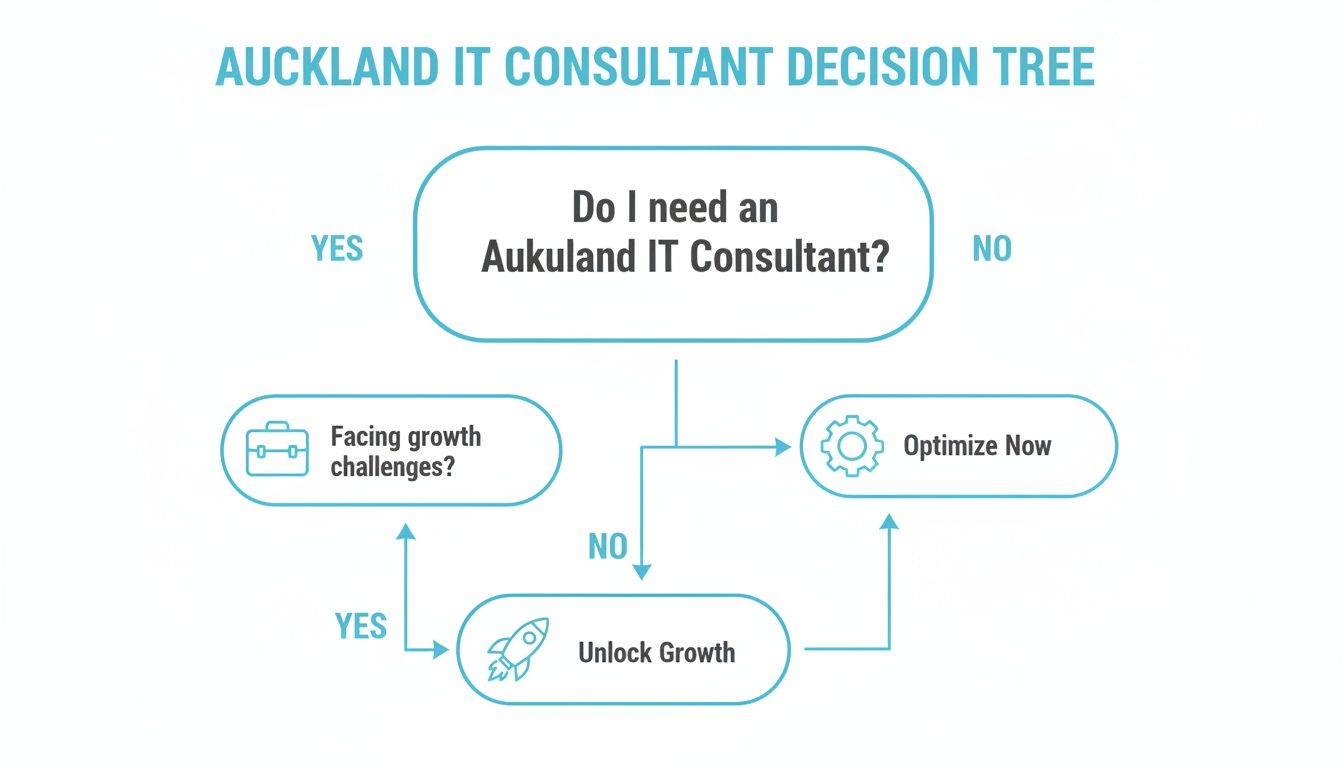
The flowchart shows a clear path: if you're facing growth challenges, the goal is to find solutions that unlock new potential. For other issues, the focus might be on optimising your current operations first to build a stronger foundation.
IT Service Match Checklist for Auckland Businesses
To make this even clearer, we've put together a checklist to help you see how specific services solve common problems for local businesses. This isn't just theory; it’s about seeing how these tools work in the real world. A well-defined brief ensures you find a partner who delivers tangible results, not just a bunch of tech jargon.
| Business Challenge | Recommended IT Service | Example Application (for an Auckland Business) |
|---|---|---|
| Missing after-hours leads and appointment bookings. | 24/7 AI Voice Agent | A Ponsonby dental clinic uses an AI agent to book appointments over the phone, ensuring no patient call is ever missed. |
| Time-consuming manual data entry from invoices. | AI Document Processing | An Albany-based construction firm automates invoice processing, extracting data directly into Xero and saving hours of admin work. |
| Inconsistent sales follow-ups and lead nurturing. | Automated Sales & Marketing Workflows | An e-commerce store in Newmarket sets up automated email sequences to follow up on abandoned carts, recovering lost sales. |
| Team struggles with a messy, manual internal process. | Custom AI Micro App | A real estate agency in Remuera uses a simple app for agents to submit new listings for approval, streamlining the entire workflow. |
By using a framework like this, you move from simply having a problem to having a concrete plan. If you're weighing your options, our guide on custom software vs. off-the-shelf solutions can provide more clarity on which path is right for your business.
The goal is to walk into a conversation with a potential IT consultant already knowing your top three problems and having an idea of the solutions you need. This positions you for a much more productive partnership focused on achieving clear business outcomes.
How to Vet and Choose Your Auckland IT Partner

Once you've mapped out what your business needs, the real work begins: finding the right people to make it happen. Sifting through the list of IT consultants Auckland has to offer is about more than just a quick Google search and a few phone calls.
You're not just buying a piece of software; you're inviting a partner into the very heart of your business operations. This calls for a solid framework to look past the sales pitch and see how they truly operate. Are they invested in your success? A great consultant should feel like an extension of your own team.
Look for Proven Industry Experience
Generic IT support is one thing. But building smart, effective automation demands a much deeper understanding of how your specific industry works. A solution that’s a game-changer for a retail store in Newmarket could be completely useless for a construction firm in Albany. Industry-specific experience isn't just a nice-to-have; it's essential.
When you're talking to a potential partner, don't let them get away with a simple "yes, we've worked in your sector." You need to dig deeper.
For instance, a real estate agency in Ponsonby shouldn't settle for, "Can you automate our leads?" Get specific and see how they respond:
- How would you get a qualified lead from our website form and put it directly into an agent's calendar as a viewing appointment?
- What's your approach for an automated email sequence that keeps a cold lead warm over six months?
- Can you set up a workflow that sends a 'thank you' message and a feedback request right after a property viewing?
These kinds of questions force them to show their hand. You’ll quickly find out if they have genuine, hands-on experience or if they’re just trying to fit you into a generic box.
The right IT partner doesn't just know the technology; they know your business. They should be able to speak your language and see around corners, anticipating challenges you haven't even thought of yet.
Clarify Their Process and Integration Strategy
Any consultant worth their salt will have a clear, transparent process for getting you from A to B. Vague promises of "don't worry, we'll handle it" are a major red flag. You need to know exactly what to expect at every stage, from the initial chat to the final launch and ongoing support.
Ask them to walk you through their standard project timeline. You're looking for a structured approach - something like a 'discover, build, launch' model - which shows they have a reliable system that keeps projects on track and on budget.
Just as critical is their plan for integration. Your business already runs on a set of tools, whether it’s Xero for accounting, HubSpot for your CRM, or Shopify for e-commerce. Any new solution must play nicely with your existing software stack, not force you to overhaul everything.
Here are a few sharp questions to ask about integration:
- How do you guarantee a smooth connection between your automation and our current systems, like Xero or MYOB?
- What's your testing process to make sure no data gets lost or corrupted during integration?
- Can you share a real-world example of connecting a client's older, legacy system with modern AI tools?
Knowing how to bridge the gap between old and new technology is a vital skill. For businesses running on older platforms, understanding the essentials of legacy system integration will give you a better sense of what's involved.
Scrutinise Security and Support Protocols
Handing over the keys to your business processes and data requires a massive amount of trust. That trust has to be earned with rock-solid security and a clear plan for support when you need it. Security can't be an afterthought; it has to be baked in from the start.
Don't be shy about asking direct questions:
- Data Encryption: Is our data encrypted both in transit and at rest?
- Compliance: How do you ensure everything you build complies with New Zealand's Privacy Act?
- Access Control: What policies do you have to control who on your team can access our systems?
A reputable consultant will have clear, confident answers. You should be hearing phrases like "enterprise-grade, bank-level encryption" as their standard, not an optional extra.
Demystify the Service Level Agreement (SLA)
Finally, let’s talk about what happens when things go wrong. Because eventually, they do. What's the plan when a critical system fails at 8 PM on a Friday? This is where the Service Level Agreement (SLA) becomes your best friend. It’s a formal contract that defines response times, system uptime, and exactly what level of service you can expect.
Read the SLA carefully. Zone in on these details:
- Response Times: How quickly will they jump on a critical issue versus a minor question?
- Support Hours: Is support strictly 9-to-5, or do they have after-hours help available?
- NZ-Based Support: When you call for help, will you be talking to someone in New Zealand who gets the local business landscape?
Having New Zealand-based support is a huge plus. It means you’re not stuck in a queue for an overseas call centre or battling frustrating time zone delays when you need a problem sorted right now. A strong SLA, backed by a local team, is what gives you the confidence to move forward.
Understanding Costs and Calculating Your Return on Investment
Let's get straight to the point: what's this going to cost? When you're looking at bringing in IT consultants in Auckland, price is obviously a huge factor. But here's a crucial mindset shift: you're not just buying a service; you're making an investment. The real question isn't about the cost, but the return you'll get from it.
You'll find a few different ways consultants structure their pricing. While traditional IT support might still work on hourly rates or fixed project fees, the AI and automation space generally favours subscription models. This is actually great for businesses because it means you can dip your toes in, see the results, and then scale up.
This subscription approach puts powerful technology within reach for pretty much any Kiwi business, without needing a massive upfront cheque.
Common Pricing Models Explained
As you start getting quotes, you'll see a few pricing structures pop up. Knowing the difference helps you properly compare your options and find what works for your business.
- Hourly Rates: Best for small, one-off jobs or a quick fix. It’s flexible, but for anything substantial, costs can quickly spiral, making it a nightmare to budget for.
- Project-Based Fees: A single, fixed price for a specific outcome, like setting up an automated client intake system. This gives you cost certainty, which is fantastic for planning.
- Monthly Subscription/Retainer: This is the most common model for ongoing services like AI automation. You pay a recurring fee that covers specific automated workflows, support, and maintenance.
For most Auckland businesses exploring automation, a subscription makes the most sense. A single, high-impact automated workflow - say, one that handles all your client onboarding - can start from around $99 per month. It becomes a predictable operational expense, not a huge capital hit.
The price tag itself is almost irrelevant. A $249 monthly subscription that frees up 20 hours of your team's time every single week isn't a cost - it's one of the best investments you'll ever make.
Shifting Focus from Cost to ROI
This is the most important part of the whole conversation: figuring out your return on investment (ROI). This is where you look past the consultant's invoice and measure the real, tangible impact on your business. It’s what separates viewing IT as a necessary evil from seeing it as a powerful growth driver.
Calculating ROI doesn't have to be complex. A great starting point is direct savings. For example, if an AI Document Processing tool saves your admin person five hours a week on data entry, and you pay them $30 an hour, that's an immediate saving of $150 a week. That’s $7,800 a year back in your pocket. A monthly fee of a couple of hundred dollars suddenly looks like a no-brainer.
But the real value often lies beyond simple time savings. What’s the value of an AI Voice Agent that captures five qualified leads for you every month after you've all gone home? If just one of those leads converts into a $5,000 project, the system has paid for itself many, many times over. You can dive deeper into this with our guide to calculating the ROI on AI workflow automation.
The numbers back this up. New Zealand's IT services market is booming, hitting $14.5 billion in total sales in 2023 - a massive 28% jump from 2021. This surge, highlighted in recent industry reports, shows how seriously Kiwi businesses are investing in tech to get ahead. For any business owner in Auckland, it's clear proof that partnering with the right IT consultants is a proven way to unlock serious efficiency.
By focusing on these returns - both in hours clawed back and new opportunities gained - you can make a confident, data-backed decision. The conversation shifts from "Can we afford this?" to "How quickly can we get this started?"
Your First 30 Days: From Idea to Impact

You've done the hard yards, vetted your options, and signed on with one of the best IT consultants Auckland has to offer. So, what happens now? The first month is where we lay the foundation for your success, and any professional partner worth their salt will have a clear plan to get you results, fast.
Forget about those endless projects that take months to show any value. Modern IT consulting, especially in AI automation, is all about speed and tangible impact. Most of our solutions, whether it's a new AI workflow or a 24/7 Voice Agent, are typically up and running in just two to three weeks.
This rapid deployment comes down to a proven 'discover-build-launch' model. It’s a straightforward, three-phase process designed to take you from your current pain points to a fully working solution without any fuss. You’ll know exactly what’s happening at every step.
Phase 1: Discovery and Mapping
This first phase is the most important, and it usually only takes a few days. It's a deep dive into your existing processes to understand precisely how your business operates. We won't just ask what you want; we'll sit down with you to map out your current workflows, step-by-step.
This is a team effort. You’ll walk us through how a lead comes in, how a quote is created, or how a new client is onboarded. The goal here is to find the bottlenecks, the repetitive tasks, and the areas ripe for what we call 'quick wins'.
These are high-impact automations that can be rolled out swiftly to deliver immediate value. For a trades business in Auckland, a quick win might be automatically sending a follow-up email three days after a quote goes out. It's a simple change that can seriously boost your conversion rate from day one.
The discovery phase isn’t about tech-speak. It’s a practical, business-focused conversation to find the low-hanging fruit - the simple, powerful changes that deliver the biggest return in the shortest time.
Phase 2: The Build and Integration
Once we've mapped everything out and identified the first targets, we move into the build phase. This is where the technical work happens, but the key thing for you is that your consultant handles all of it. You don't need any tech skills whatsoever.
During this stage, which usually lasts about one to two weeks, we get to work building the custom workflows and connecting them to the software you already use.
This typically involves:
- Connecting Your Tools: Setting up secure integrations with your existing systems, like Xero, HubSpot, or your specific industry software.
- Building the Logic: Creating the automated rules, such as "when a new web form is submitted, create a client record in the CRM and assign a task to a salesperson."
- Rigorous Testing: Running the system through its paces to make sure everything works perfectly before it goes live. We check that data flows correctly and that the automation performs exactly as planned.
This phase is all about turning our plan into a reliable reality. We’ll keep you updated on progress without drowning you in technical jargon.
Phase 3: Launch and Monitoring
This is the final stage - when your new, automated system is switched on and starts working for you. But our job doesn't end there. We’ll provide training for your team to make sure everyone is comfortable with the new tools and understands how they fit into the daily routine.
Crucially, the first few weeks after launch involve close monitoring. We keep a close eye on the performance of the new workflows to iron out any kinks and confirm you're getting the results you expect. You'll receive clear reports showing key metrics, like hours saved or leads captured, proving the value of your investment right from the start.
Got a Few Lingering Questions?
Even after seeing the potential, it's completely normal to have a few final questions before bringing an IT consultant in Auckland on board. This is a big step for any Kiwi business, and getting straight answers is key to feeling confident about your decision.
A question I hear a lot is, "Are we actually ready for this?" Here's my rule of thumb: if you or your team are constantly bogged down by repetitive manual tasks, losing leads after hours, or just feel your processes are clunky, it's time. A good consultant can spot those 'quick wins' straight away - things like automating data entry into Xero or setting up an AI Voice Agent to capture leads 24/7 - delivering value right out of the gate.
What About Security and All the Tech Stuff?
Data security is, rightly, a major concern. You should expect enterprise-grade security as a non-negotiable standard. Any professional consultant will use bank-level encryption for your data, both in transit and at rest. They absolutely must be compliant with New Zealand's Privacy Act and be able to walk you through exactly how they secure integrations with your current software.
Another common worry is how much technical know-how you need to have. The short answer? None. A great consultant's job is to shoulder all that complexity for you. They should talk to you in plain English, focusing on the business outcomes - "save 10 hours a week on invoicing" - not the jargon behind it. Their process should be end-to-end, covering everything from the initial chat and setup to ongoing support.
The real measure of a good IT partner isn't their technical vocabulary, but their ability to make sophisticated technology feel simple and deliver results you can see on your bottom line. They handle the complexity so you can focus on your business.
Auckland's IT specialists are a huge part of why New Zealand's tech sector is booming, adding a massive 46,937 new jobs between 2000 and 2023. This growth just shows how crucial consultants have become for SMEs, offering scalable solutions with clear pricing. For example, our own tiered plans at Automate AI start at just $249/month for five powerful workflows. You can learn more about New Zealand's thriving tech sector and see the bigger picture.
Am I Going to Be Locked into a Long Contract?
Finally, there's the fear of being trapped in a rigid, long-term contract. Thankfully, that's becoming a thing of the past. Modern IT providers, especially in the AI automation space, lean towards flexible monthly subscriptions. This approach lets you start small, prove the return on investment with a single workflow, and then scale up as your confidence and needs grow. Always ask about the terms, of course, but look for partners who offer the flexibility your business needs to stay agile.
Ready to see how intelligent automation can give your Auckland business a real advantage? At Automate AI, we specialise in practical, high-impact solutions that save you time and drive growth.
Book a free, no-obligation strategy call with our team today and let's find your first quick win.
Found This Helpful?
Book a free 30-minute discovery call to discuss how we can implement these solutions for your business. No sales pitch, just practical automation ideas tailored to your needs.
Automate AI Team
AI Automation Expert at AutomateAI


