AI Process Automation NZ: A Practical Guide for Kiwi SMEs
Feel like you're drowning in paperwork and constantly trying to keep pace with competitors? You're not the only one. For a growing number of Kiwi businesses, AI process automation in NZ is proving to be the answer, freeing up teams to focus on what really matters - growth - instead of getting bogged down by admin.
The Tipping Point for AI Automation in New Zealand
Are your best people spending their days on jobs that a machine could do in seconds? Just think about the collective hours lost to manually sending quotes, chasing up invoices, or fielding the same basic customer questions day in and day out. This is the reality for many New Zealand businesses, a tipping point where old-school manual processes just can't keep up anymore.
There’s a lot of noise around Artificial Intelligence, but for pragmatic Kiwi business owners, it all boils down to one question: "What can it actually do for my business?" This guide is designed to cut through the hype and give you a straightforward, practical path forward.
From Buzzword to Business Tool
AI process automation isn't some far-off concept anymore; it's a real tool that local businesses are putting to work right now to get an edge. At its core, it's about teaching software to handle the predictable, rules-based tasks that eat up your team's schedule. Think of it as a digital team member who works 24/7 without ever needing a coffee break, making sure everything runs like clockwork.
The goal isn't to replace your talented staff but to empower them. By automating the mundane, you free up your team to focus on high-value work like building client relationships, strategic planning, and innovation.
For many SMEs, making this shift is becoming essential. As we've explored in our article on the future of work with AI in NZ, getting on board early creates a serious competitive advantage. This guide will be your roadmap, helping you move from simply being curious to seeing real results.
We'll show you how to:
- Pinpoint the exact tasks that are costing you the most time and money.
- Understand how surprisingly simple automations can solve these headaches.
- See practical examples from NZ industries like real estate, healthcare, and construction.
- Calculate the direct impact automation can have on your team's productivity and your bottom line.
What Is AI Process Automation and Why It Matters Now
At its heart, AI process automation is all about handing over the repetitive, time-draining tasks that fill up your day to a team of smart digital assistants. Think of intelligent software that can draft and send out quotes, chase up overdue invoices, or field common customer questions, all on its own.
This isn't about replacing your valuable people; it's about making them more effective. By letting AI handle the mundane but critical work, you free up your team to focus on what really grows your business - building client relationships, thinking strategically, and innovating.
And this technology is no longer some far-off dream reserved for massive corporations. For Kiwi businesses, embracing AI process automation in NZ has become essential for staying competitive and efficient in a market that moves at lightning speed.
Moving Beyond Basic Automation
We've had traditional automation for years, mostly in the form of rigid "if this happens, then do that" rules. A simple email auto-responder is a perfect example. But AI process automation is a massive leap forward, injecting a layer of intelligence into these old-school workflows.
Instead of just following a strict script, AI can understand the context of a situation, make decisions based on the information it has, and even learn over time. This lets it handle much more complex scenarios that would usually need a person to step in. A great example of this in action is Intelligent Document Processing, where AI learns to read, understand, and pull key data from documents like contracts or supplier invoices.
The Urgency for New Zealand Businesses
The shift to AI is happening a lot quicker than many business owners think. Recent data reveals that in 2025, an incredible 87% of New Zealand organisations will be using AI in some form - that's a huge jump from just 48% in 2023. This rapid uptake puts Kiwi businesses ahead of the curve globally, and the results are compelling: 95% of those who've adopted it report a boost in revenue, with efficiency gains not far behind at 91%.
This isn't just another trend. It’s a fundamental change in how modern, successful businesses get things done. Sticking to the old ways means you risk being left behind by more agile competitors who are already enjoying lower costs and higher productivity.
The table below paints a clear picture of just how different the old manual methods are from a modern, AI-driven approach.
Manual Tasks vs AI Automated Workflows
Here’s a direct comparison that shows the real-world business impact of automating a few common administrative and client-facing tasks.
| Business Process | Traditional Manual Method | AI Automated Method (The Automate AI Way) |
|---|---|---|
| New Customer Onboarding | Staff manually send welcome emails, create accounts, and schedule follow-up calls. It's slow and prone to human error. | AI instantly triggers a personalised welcome sequence, sets up the client in your CRM, and books an introductory call in your team's calendar. |
| Invoice Processing | An admin manually types invoice data into Xero or MYOB, matches it to purchase orders, and chases payments via email. | AI extracts all data from PDF invoices, enters it into your accounting software, flags any issues, and sends automated payment reminders. |
| Answering Customer Queries | Your team spends hours answering the same questions about business hours, services, or appointment availability. | An AI Voice Agent or chatbot gives instant, 24/7 answers to common questions, only handing over the more complex issues to your human team. |
As you can see, the difference isn't just about saving time - it's about creating a more reliable, professional, and scalable operation from the ground up.
Real-World Examples of AI Automation Across NZ Industries
Theory is one thing, but seeing how AI process automation actually works in the real world is where it all clicks. This isn't some futuristic concept; businesses right here in New Zealand are already using it to solve nagging problems, slash admin time, and give their customers a much better experience.
Let's look at some tangible examples of what this looks like on the ground.
Take a busy real estate agency in Auckland. Think about the hours spent after every open home manually sending follow-up emails and texts to every single person who walked through the door. Now, an automated AI workflow does it all instantly. It contacts every visitor, thanks them for their time, and asks if they have any questions. This alone is saving the team up to 10 hours of admin per week.
Suddenly, agents are freed up to do what they do best - building relationships and closing deals. If you're in the property game, you can dive deeper into how real estate AI automation helps close more deals in NZ and gives you a serious competitive edge.
Boosting Efficiency Sector by Sector
The beauty of AI process automation is how adaptable it is. It’s making a difference in nearly every corner of the NZ economy. While each industry has its own unique headaches, the solution is often the same: get the machines to handle the repetitive, high-volume tasks so your skilled people don't have to.
Just imagine these scenarios:
- Healthcare Clinics: A medical centre in Christchurch now offers 24/7 appointment booking. An AI Voice Agent handles after-hours calls, securely books patients into the practice management system, and sends out confirmations - all without a receptionist in sight.
- Construction and Trades: A Wellington plumbing company put its quoting process on autopilot. A new website enquiry triggers an AI system that gathers the job details, whips up a standard quote from a template, and emails it to the potential client within minutes.
- Legal Firms: A law practice has completely sorted its client intake. AI tools scan new client forms, pull out the key information, create a new case file in their system, and even schedule the first consultation. They’ve cut client onboarding time in half.
From Public Service to Private Enterprise
And this isn't just a private sector phenomenon. In fact, New Zealand's government agencies are jumping in with both feet. The latest government survey found 272 distinct use cases across 70 agencies - that's more than double the previous year. This shows AI has moved from small-scale trials to being a core part of operations.
The core takeaway is this: if a government department can automate complex public service requests, a Kiwi SME can most certainly automate its invoice reminders or customer follow-ups.
These examples make one thing clear: AI process automation isn’t reserved for massive corporations with bottomless IT budgets. It's a practical, accessible tool that helps small and medium-sized businesses all over New Zealand get more organised, respond faster, and ultimately, compete more effectively. It’s all about solving real problems and getting results you can actually see and measure.
Your Practical Roadmap for AI Automation
Ready to move from theory to action but not sure where to start? Bringing AI automation into your business doesn't have to be some massive, daunting project. We follow a clear, practical plan designed to get you real results fast - often in just a matter of weeks.
Our entire approach is built around three simple, managed stages. This keeps everything transparent from day one and focuses on getting you a return on your investment as quickly as possible. The best part? It's a fully managed process, so your team doesn't need any technical skills at all.
Stage 1: Discover and Identify Quick Wins
First things first, we need to find the best place to start. This is the most crucial step. We'll work with you to pinpoint the "low-hanging fruit" - those repetitive, high-volume tasks that are chewing up your team's time and causing frustrating bottlenecks. Think manually keying in invoice data or chasing clients with follow-up emails.
During this discovery phase, we map out your current workflows to spot the quick wins that will deliver the biggest impact with the least amount of disruption. The goal is to choose one or two core processes where automation can immediately free up a significant number of hours and improve accuracy.
Stage 2: Build and Integrate Your Solution
Once we’ve locked in the target processes, our experts get to work. In the 'Build' stage, we connect the tools you already use - like Xero for your accounts or HubSpot for your customer relationships - into one seamless, automated workflow.
This isn't a tech project for you or your staff. We handle all the heavy lifting, building the digital plumbing that lets your different systems talk to each other and get things done on their own. Your involvement is purely about sharing insights into how your business operates, not fiddling with the technology itself.
The infographic below shows how straightforward this flow is - from spotting a business problem to putting a solution in place and seeing the positive results.
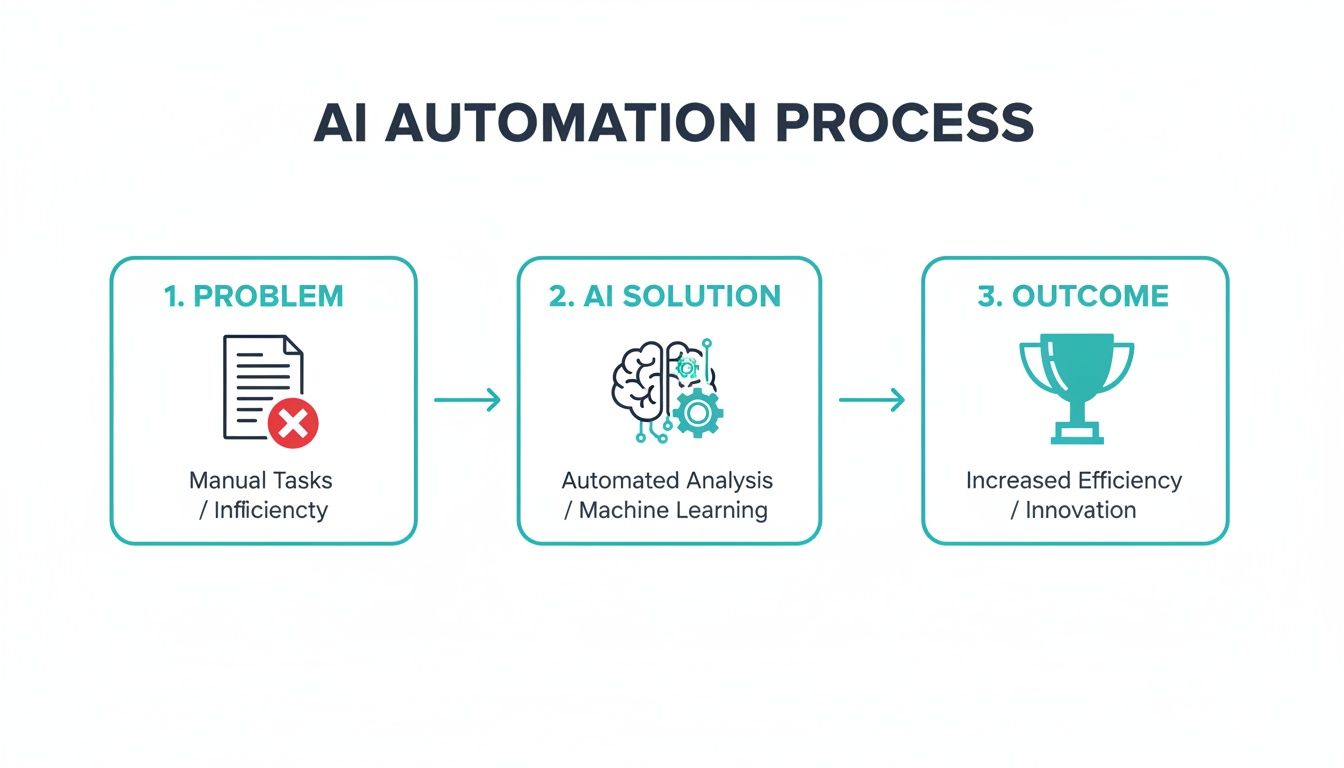
As you can see, it all starts with a manual pain point, moves to applying a specific AI solution, and ends with a measurable win for your business.
Stage 3: Launch and Measure Your ROI
The final step is the 'Launch'. This is when your new automated workflows go live, and you start seeing the benefits almost instantly. But our job isn't done. We provide continuous monitoring to make sure everything runs smoothly, 24/7.
A huge part of the launch is actually measuring the success. We give you simple, clear weekly reports showing exactly how much time your team is getting back and what tasks have been completed. This makes it incredibly easy to track your return on investment and see the real-world impact on your bottom line.
This three-step process is built for speed and effectiveness. To get a better idea of how this could look for your business, check out our guide on Your 30-Day Automation Quick Wins Roadmap for NZ Business. It’s all about creating value in weeks, not months.
Calculating the ROI of AI Automation for Your Business
Any smart business decision eventually comes down to the numbers. So, how does investing in AI process automation actually help your bottom line? It’s all about understanding your Return on Investment (ROI) – and it goes much deeper than just clawing back a few hours.
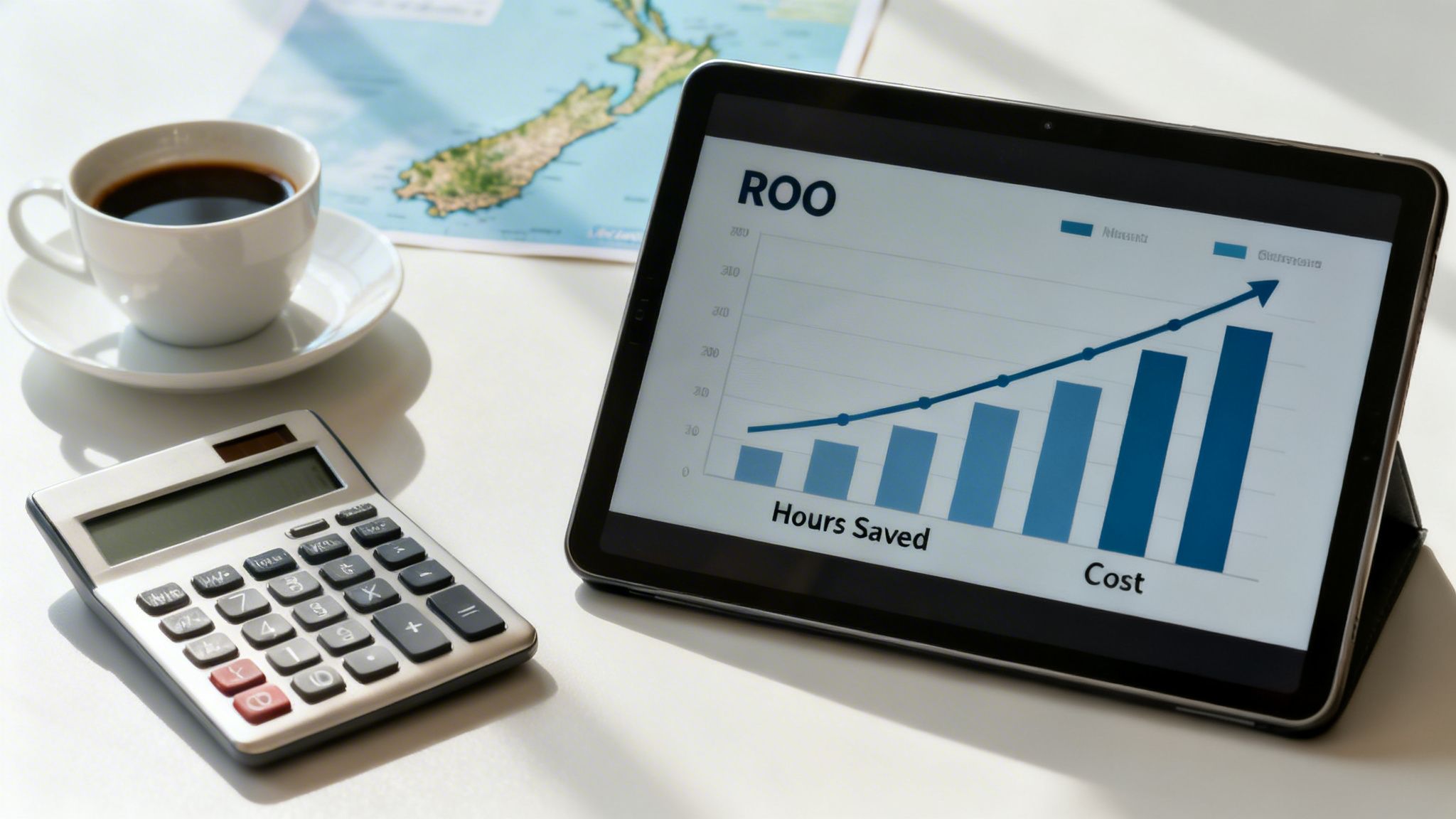
The simplest place to start is by putting a dollar value on the time you save. If automation frees up a team member for 10 hours a week, that's time they can now sink into high-value work - like nurturing client relationships or innovating new services - instead of being stuck on admin. This is a direct, measurable productivity gain.
But the financial upside doesn't stop there. AI automation also directly cuts operational costs. It significantly reduces the risk of human error in tasks like invoicing or data entry, preventing those costly mistakes that can take hours of someone's time to unravel. Plus, quicker response times mean happier customers, which in turn boosts loyalty and increases the lifetime value of every client you have.
A Simple Framework for Your Business
You don’t need a complicated spreadsheet to get a feel for the potential ROI in your own business. A good starting point is to pick just one or two processes that are notorious time-sinks or prone to mistakes.
Think about these key drivers for your return:
- Productivity Gains: How many hours does your team spend each week on a repetitive job, like chasing overdue invoices? Multiply those hours by their hourly rate, and you've got your current cost.
- Cost Reduction: What’s the real cost of a mistake? Think about how much one incorrect order or a missed invoice follow-up actually sets you back.
- Revenue Growth: This is where the opportunities lie. Faster follow-ups on new leads can have a huge impact on conversion rates. If an AI can reply to a website enquiry in seconds rather than hours, your odds of winning that business go way up.
When you break it down like this, the decision to invest becomes a lot more straightforward. To dig deeper, you can explore our guide on the AI Workflow ROI Calculator and learn if automation is worth it for your specific circumstances.
The Bigger Picture in New Zealand
The numbers from right here in New Zealand back this up. While only 12% of Kiwi organisations have fully embedded AI across their operations, the results for those who have are undeniable.
A staggering 91% report clear efficiency gains, which translates into revenue growth for 95% of them. This is a powerful signal for SMEs to move past simply being curious about AI and start taking action.
The takeaway is clear: even starting small with an entry-level plan can deliver a significant return. Automating just one core process, like client onboarding or quote generation, can pay for itself many times over by freeing up your most valuable resource - your team's time.
Right, we’ve covered a lot of ground. We’ve unpacked what AI process automation in NZ actually is, explored why it's becoming a game-changer, and looked at real-world examples that bring the concept to life. The path to a smarter, more efficient business is right there in front of you.
Now comes the important part: turning that knowledge into action.
Bringing AI automation into your business isn’t just about staying current anymore. For Kiwi businesses, it’s about getting a genuine leg-up on the competition. The best part? You don’t have to go it alone. There’s local, expert help available to make sure you get it right.
Finding the Right Partner Makes All the Difference
Choosing who to work with is probably the most important decision you'll make. A specialist partner like Automate AI takes the technical guesswork out of the equation and becomes your dedicated automation team. We're not interested in long, drawn-out projects; we focus on getting you real results, fast. We handle the entire process, from mapping out your current workflows to building and launching the final solution.
We've designed our entire process around what Kiwi businesses need most – speed and impact. Here’s what that looks like in practice:
- Proper Local Support: You’ll be working with a team right here in New Zealand who gets the local market and is available when you are. No overseas call centres, no timezone headaches.
- Seriously Fast Results: Forget about massive IT projects that take months or years. We aim to have your first automation up and running in just 2-3 weeks, so you start seeing a return on your investment almost immediately.
- A Clear Return on Investment: We build solutions that pay for themselves. It’s that simple. By freeing up your team’s time, reducing admin costs, and speeding up how you serve customers, the value becomes obvious very quickly.
Taking that first step can feel like the biggest hurdle. But it doesn't have to be a massive leap. It all starts with finding just one process - a "quick win" - that can show you and your team what's possible.
The easiest way to move forward is to just have a chat. A simple, no-pressure discovery call lets us get a handle on your biggest administrative headaches. From there, we can help you pinpoint the one process that will give you the biggest bang for your buck right from the start.
This is your launchpad to building a more productive, robust, and competitive business. Don't sit back and wait for your competitors to get there first.
Ready to find your first quick win? Book your free discovery call with Automate AI today.
Got Questions About AI Process Automation?
Diving into new technology always stirs up a few questions. For Kiwi business owners weighing up AI process automation, getting clear, straight-up answers is key to feeling confident about taking the next step. Let’s tackle some of the most common queries we hear day in and day out.
Our aim here is to cut through the jargon and give you the practical information you need to decide if this is right for your business.
Do I Need to Be a Tech Whiz to Use AI Automation?
Absolutely not. This is probably the biggest myth we come across. When you work with a specialist partner, they do all the technical heavy lifting for you. The whole thing is managed on your behalf, from pinpointing the best processes to automate right through to building and launching the solution.
Your team is simply left with an easy-to-use interface that doesn't require any coding or technical know-how. It's all the power of advanced technology, without having to become a tech expert yourself.
The whole point of AI process automation is to make your life easier, not hand you another complicated system to master. A good partner hides all the complexity behind the scenes so you can just focus on the results.
Is AI Automation Safe for Our Customer Data?
Yes, and it has to be. Security is non-negotiable. Any reputable provider will use enterprise-grade security and bank-level encryption to keep your sensitive information locked down. As a New Zealand-based company, we're also bound by our local data privacy laws, which means your business and your clients' information is always handled safely and in line with local regulations.
What's the Cost of AI Automation for a Small Business?
It’s much more accessible than most people assume. Modern AI automation services are built with SMEs in mind. You’ll find flexible plans that can start from a low monthly fee for a single, custom-built workflow. The focus is always on delivering a clear return on investment, making it a cost-effective tool that quickly pays for itself through time saved and efficiency gained.
Ready to see how Automate AI can help your business with practical, affordable automation? Book your free discovery call today and we'll help you find your first automation quick win.
Found This Helpful?
Book a free 30-minute discovery call to discuss how we can implement these solutions for your business. No sales pitch, just practical automation ideas tailored to your needs.
Automate AI Team
AI Automation Expert at AutomateAI